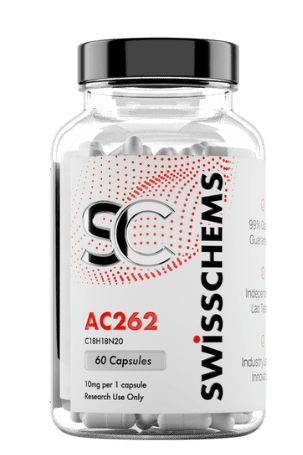
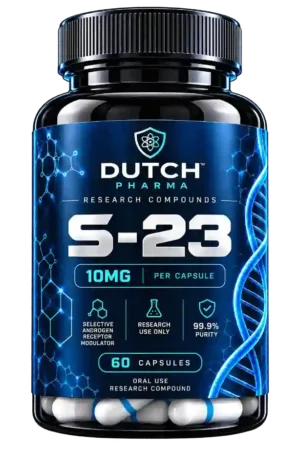

Swisschem AC-262 is a branded product whose label lists the SARM AC-262536. Those searching for the compound often come across the name Accadrine. But both names refer to the same small molecule from a research laboratory. It was discovered nearly twenty years ago, briefly tested in rats and not developed further. It has never been administered to a human as part of a study.
This text puts the product into context in three steps. First, we clarify what the brand, code and market name each indicate—and what they do not. Then we explain the principle of a partial agonist with examples from real medicine. Finally, we cover risks, legal status and answers to frequently asked questions. We explain technical terms as we go.
Five questions, answered briefly
| Question | Short answer |
|---|---|
| What active ingredient is listed on the container? | According to the label, AC-262536, an androgen receptor modulator with no steroid structure. |
| What makes it unusual? | The compound was specifically selected to activate the receptor only partially. |
| How well has it been studied? | Hardly at all. There are cell tests and a two-week animal study from the same laboratory. |
| Has it been tested in humans? | No. Neither tolerability, effects nor metabolism have been measured in humans. |
| Is it legal in Germany? | No. It is not approved and is prohibited in sport. |
Three names for one substance
AC-262536 is the original laboratory code. The letters come from the developer, a biotech company based in the US. The six digits refer to the entry in its compound library. AC-262 is simply a shortened form that has become common in online retail.
Accadrine, on the other hand, is a made-up name. It appears in no scientific publications and was not assigned by any authority. It was probably coined by retailers because a word is easier to remember than a string of numbers. AC-262536 has no official generic name of the kind the World Health Organization assigns to medicinal substances.
This matters when doing your own research. Scientific literature can only be found under the full code AC-262536. Searches for the market name, by contrast, turn up almost exclusively shop pages and forum posts.
What the Swisschem brand name tells you
A brand makes a product recognizable. For an unapproved substance, however, that is all it does. With genuine medicines, authorities monitor manufacturing, check the composition and release every batch. No such framework exists for AC-262536, as no application for approval has ever been submitted.
The name also suggests Switzerland. However, this does not establish where it was manufactured or imply official oversight. To our knowledge, Swissmedic, the Swiss Agency for Therapeutic Products, has never approved AC-262536. We make no claims about Swisschem’s registered office, production or testing procedures because we have no verifiable documentation on these matters.
What a label cannot prove
- Identity: whether the product really contains AC-262536 and not another, potentially more potent substance.
- Spatial configuration: whether the hydroxy group has the correct spatial orientation. The so-called endo form was studied. An exo form with a different spatial structure would be a different molecule with an unknown effect.
- Amount: whether each capsule actually contains the amount stated on the label.
- Impurities: whether residues from synthesis, solvents or foreign active ingredients are present.
Only an analysis of the specific batch can answer these questions. A meaningful laboratory report identifies the testing laboratory, batch number and methods. Typical methods include chromatography, which separates the components, and mass spectrometry, which can confirm the molecular weight of around 278 g/mol. A nuclear magnetic resonance measurement, or NMR, would additionally show the spatial arrangement.
How AC-262536 was discovered
Many SARMs are derived from older medicines. Enobosarm, for example, is chemically related to drugs used to treat prostate cancer. AC-262536 was discovered differently. The researchers automatically screened a large collection of diverse molecules using a cell-based assay. In this test, the cells multiplied only when a substance activated the androgen receptor.
This brought a previously unknown family of molecules to light. Its structure combines a naphthalene double ring with a nitrile group and a compact, bridged nitrogen ring. The team selected AC-262536 from this family. Apparently, the deciding factor was not the greatest potency. Rather, the substance bound strongly while still producing only a limited response.
Partial agonist explained
A receptor is a receiving site for messengers. A substance that binds to it has two independent properties. The first is affinity: how strongly it binds. The second is intrinsic activity: how strongly it activates the receptor after binding. A molecule can bind very tightly and still trigger only a limited response.
An everyday example helps explain this. Some headphones have a built-in volume limiter. You can turn the dial all the way up, but the sound still will not exceed the set limit. Testosterone is like a device without a limiter. AC-262536 is like a device with one: even when all the receptors are occupied, the response remains capped.
Well-known examples in medicine
Partial agonists are not exclusive to the SARM scene. Medicine has used them for decades at entirely different receptors. Three examples show how the principle works in practice:
- Buprenorphine acts only partially at the opioid receptor. As a result, dangerous respiratory depression levels off at higher amounts, which is known as the ceiling effect.
- Varenicline partially stimulates the nicotine receptor. This reduces cigarette cravings without producing nicotine’s full effects.
- Aripiprazole is a partial agonist at the dopamine receptor and is used in psychiatry.
All three active ingredients have one important thing in common. When a partial agonist encounters a full agonist, it partially displaces it from the receptor. This can even reduce the overall signal. This effect is well known with buprenorphine and can trigger withdrawal symptoms in people who are dependent on opioids. Applied to AC-262536, this means that in a man with normal testosterone levels, the substance could block some of the body’s own effects instead of enhancing them. However, no one has measured this.
Not a steroid, but still an androgen
Because AC-262536 does not have a steroid structure, the body cannot convert it into estrogen or DHT. The enzymes responsible, aromatase and 5α-reductase, only recognize steroids. Some retailers promote this very point. However, that does not mean the substance is hormonally neutral. It occupies the same receptor as testosterone and sends an androgenic signal, just with limited potency. Typical androgen-related effects, such as suppression of the hormonal axis or changes in blood lipids, therefore remain possible. Not being converted only protects against some of the problems associated with steroids.
What the research actually shows
The evidence base is anchored by a steroid biochemistry paper published in 2008. In 2009, the same group followed up with a chemistry paper on related molecules. We are not aware of independent studies from other laboratories. The table compares the findings with what they do not establish.
| Finding | What it shows | What it does not show |
|---|---|---|
| Binding in the low nanomolar range | The compound binds tightly to the androgen receptor. | How much of it reaches the bloodstream after being swallowed |
| Only partial activation in cells | The principle of partial agonism works in a test tube. | Whether this limiting effect also applies in human tissues |
| Little effect on 47 other nuclear receptors | The binding is fairly selective. | Whether it has effects on entirely different targets |
| Inhibition of prostate cancer cells (LNCaP) stimulated with a potent androgen | The compound can partially displace a full signal. | Whether this could lead to a treatment |
| Castrated rats over two weeks | A small pelvic floor muscle grew, the prostate and seminal vesicles barely responded, and LH levels fell. | Effects in healthy animals, over several months, or on strength and endurance |
The muscle in the rat study
The main measurement was the weight of the levator ani. This is a muscle in the rat’s pelvic floor that is exceptionally sensitive to androgens. It has been used as a standard measure for decades because it responds quickly and clearly. However, it is only of limited relevance to human arm or leg muscles. It is often reported that AC-262536 achieved about two-thirds of the effect of testosterone here. This figure comes from the summary of the animal study and applies only to this model.
The LH signal
Castrated rats no longer produce their own testosterone. Their pituitary gland therefore releases large amounts of LH, the messenger that normally stimulates the testes. AC-262536 reduced this level. Consequently, the compound reaches the brain’s hormonal control system and is recognized there as an androgenic signal. In a healthy man, this would therefore be expected to reduce his own hormone production. The frequently repeated claim that Accadrine does not suppress anything thus contradicts the developers’ own data.
Which testing steps are missing
Before a new active substance may be given to humans for the first time, it must pass a series of required studies. The overview shows how far AC-262536 has progressed along this path.
| Testing step | Purpose | Status for AC-262536 |
|---|---|---|
| Cell tests | Measure binding to and activation of the target | Published |
| Short-term efficacy trial in animals | Check whether the principle works in the body | Published, two weeks |
| Pharmacokinetics | Determine absorption, distribution, metabolism and excretion | Not published |
| Toxicology over weeks to months | Identify damage to the liver, heart, blood and genetic material | Not published |
| Phase 1 study | Initial tolerability testing in a small number of healthy volunteers | Not conducted |
| Phase 2 and 3 | Demonstrate benefits and risks in patients | Not conducted |
The reason development stopped was never explained. The company later focused on treatments for the nervous system. Whether poor absorption, concerning toxicity findings or commercial reasons were decisive remains unclear. One thing is certain: the very data needed to determine safety are missing.
Potential risks and how well they are understood
Without human data, risks can only be inferred. The table therefore clearly distinguishes between what has been established and what remains a reasoned assumption.
| Area | Possible effect | How certain is the evidence? |
|---|---|---|
| Hormonal axis | Lower testosterone production, reduced sperm production, symptoms after stopping | LH reduction in animals established; extent in men unknown |
| Displacement | Weaker overall signal despite normal testosterone levels | Follows from the mechanism of action; never measured |
| Cholesterol | Decrease in protective HDL | Observed with other SARMs in human studies; not investigated here |
| Liver | Increased liver enzyme levels, and in some cases liver damage | Described in case reports involving other SARMs; nothing is known about AC-262536 |
| Unknown effects | Effects on organs that have never been studied | Cannot be assessed due to a lack of long-term toxicology data |
| Incorrect contents | Different active ingredient or quantity | Repeatedly found in tests of SARMs sold online |
Who is at particularly high risk
- Adolescents whose growth plates and hormonal systems are still developing
- Women, in whom androgens can cause lasting changes to the voice, hair growth and menstrual cycle
- Pregnant and breastfeeding women
- People with liver, heart or lipid metabolism disorders
- Men who want to have children
- People with a history of hormone-dependent tumours
Anyone who has already taken such a substance and is concerned can discuss it openly with a doctor. Doctor-patient confidentiality protects this conversation. Tests often include hormone levels such as testosterone, LH and FSH, as well as liver function, blood lipids and a complete blood count. Yellow eyes, very dark urine or pale stools are warning signs that should be checked promptly.
Doping, the law and customs
The World Anti-Doping Agency bans SARMs as a whole group under section S1.2. This ban applies both in competition and during training. To our knowledge, AC-262536 is not specifically listed by name, but it belongs to this group. For athletes, only the test result matters, even if a mislabelled product was to blame.
Several sets of regulations apply in Germany:
- Medicinal Products Act (AMG): A substance intended to deliberately alter bodily functions is a medicinal product. It may not be marketed without authorisation.
- Food law: AC-262536 is not permitted as a food supplement. It is not known as a food, nor does it have Novel Food authorisation.
- Anti-Doping Act (AntiDopG): The annex lists SARMs as a group. Trading them for doping purposes is a criminal offence, and even possession of a quantity above the threshold can have consequences.
- Customs: Shipments from abroad, including from Switzerland, may be inspected and detained.
- Switzerland: It is not authorised there either. A reference to Switzerland in a brand name does not change the legal situation in Germany.
A notice such as “for research purposes only” does not offer protection. What matters is the intended use of a product as indicated by the circumstances, and who it is intended for.
Frequently asked questions about Swisschem AC-262
Is Swisschem AC-262 a different substance from AC-262536?
Not according to the label. The brand name does not change the active ingredient behind the code. However, only laboratory testing can determine whether a particular container actually contains AC-262536.
What does Accadrine mean?
It is an unofficial trade name with no scientific basis. It refers to the same laboratory substance. Studies and databases only list the code AC-262536.
Does the product come from Switzerland?
We cannot confirm that. A name that sounds Swiss is not proof of origin. To our knowledge, it has not been approved by Swissmedic.
Is AC-262 weaker and therefore safer than RAD-140?
In a cell assay, it activated the receptor less strongly than testosterone. However, this does not mean it is better tolerated. At least one small human study has been conducted on RAD-140, but not a single one on AC-262536.
Can a partial agonist suppress the body’s own testosterone?
That is possible in two ways. First, the substance lowered LH in rats, the signal that activates the testes. Second, a partial agonist can displace the body’s own androgens from the receptor. Neither effect has ever been studied in humans.
Is AC-262536 available by prescription?
No. No country has approved a medicine containing this active ingredient. Therefore, no doctor can prescribe it through regular channels.
Conclusion
Swisschem AC-262 goes by three names at once: a brand, a laboratory code and the market name Accadrine. None of these replaces verified data. The molecule is scientifically interesting because, as a partial agonist, it was intended to trigger only part of the androgen signal. However, this concept has only been demonstrated in cells and in a two-week trial in castrated rats.
Even this short trial showed an effect on hormonal regulation. Pharmacokinetics, long-term toxicology and any human studies are still lacking. Legally, the substance is neither a medicine nor a food supplement in Germany, and it is prohibited in sport. An endocrinology or sports medicine practice can provide more reliable answers to questions about hormones, training or body composition than any label.