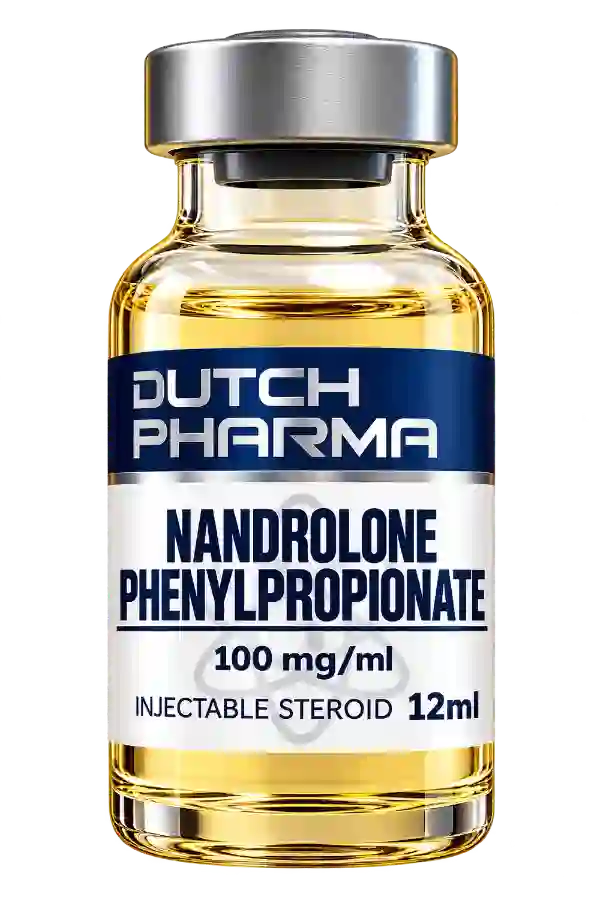


Nandrolone Phenylpropionate 100, usually simply called NPP in professional circles, is an active ingredient with a long medical history. In the late 1950s, it was among the very first nandrolone preparations. At the time, doctors used it to treat anemia, bone loss, and severe weight loss following serious illnesses. Today, NPP plays virtually no role in German medical practices. However, nandrolone continues to appear regularly in doping tests.
This guide explains step by step what NPP is and how it differs from the better-known nandrolone decanoate. It also looks at what benefits research has confirmed, what risks it describes, and what German law says about it. You don’t need a degree in chemistry. We explain each technical term the first time it comes up.
What is Nandrolone Phenylpropionate 100?
Nandrolone is an anabolic-androgenic steroid, or AAS for short. Its chemical name is 19-nortestosterone. That already tells you a lot: it is a form of testosterone that is missing a single methyl group at position 19. The human body itself even produces trace amounts of nandrolone, for example during pregnancy. However, these amounts are nowhere near enough to produce a measurable effect.
Pure nandrolone would be broken down very quickly after an injection. That is why an acid group, known as an ester, is attached to the molecule. In NPP, this is 3-phenylpropionic acid, a short carbon chain with a benzene ring at the end. The ester makes the active ingredient more fat-soluble. As a result, it stays longer in the oily depot in the muscle and enters the bloodstream gradually.
The number 100 indicates 100 mg of nandrolone phenylpropionate in every milliliter of oil. Because the ester is relatively heavy, it accounts for one-third of this weight. That leaves around 67 mg of free nandrolone per milliliter.
Key points at a glance
- NPP is a short-chain ester of nandrolone, or 19-nortestosterone.
- The active ingredient was formerly approved as a human medicinal product in several countries.
- There is currently no finished medicinal product containing NPP on the market in Germany.
- Nandrolone strongly suppresses the body’s hormone production and also has a progestogenic effect.
- The Anti-Doping Act explicitly lists nandrolone as a doping agent.
A brief history of nandrolone
Nandrolone was first synthesized in 1950. At the time, chemists had just learned how to make targeted changes to steroid structures. They hoped this would help them find a hormone that strengthened muscles and bones without causing as much masculinization as testosterone. In animal studies, 19-nortestosterone appeared to fit the bill.
In 1959, a Dutch pharmaceutical manufacturer launched phenylpropionate as a medicinal product. Just three years later, decanoate followed, with its longer ester chain. Both preparations quickly became widely used. In the 1960s and 1970s, they were considered standard treatments in many countries for patients who had become severely weakened.
Over time, however, their use became increasingly limited. One important reason was the introduction of genetically engineered erythropoietin (EPO) in the late 1980s. This hormone treats anemia in people with kidney disease more precisely and with more predictable side effects. New medicines for osteoporosis also became available. As a result, many manufacturers gradually withdrew their nandrolone preparations from the market.
What “19-nor” means for its effects
At first glance, the missing methyl group may seem like a tiny detail. In fact, it changes how enzymes in the body process the molecule. Two metabolic pathways are crucial here.
Conversion by 5α-reductase
Testosterone is converted into dihydrotestosterone (DHT) in the prostate, skin, and scalp. DHT binds more strongly to the androgen receptor than testosterone itself. With nandrolone, the opposite happens. The same enzyme converts it into 5α-dihydronandrolone, which has a weaker effect at the receptor than the original compound.
That is exactly what explains nandrolone’s reputation as “less androgenic.” In tissues with high levels of 5α-reductase, its potency decreases, while in muscle it hardly does. However, it is important to note that a weaker effect on the skin or hair does not mean there is no effect at all. Acne, hair loss and, in women, a deeper voice are also well documented with nandrolone.
Aromatisation to estrogen
The enzyme aromatase converts testosterone into estradiol, the most important estrogen. Nandrolone can also be aromatised, but the conversion rate is significantly lower. Various studies estimate it to be a fraction of what occurs with testosterone. Nevertheless, estrogen levels can rise with nandrolone, especially at high doses.
The progestogenic effect
A third property is often overlooked. Nandrolone binds not only to the androgen receptor, but also to the progesterone receptor. This means it has some progestogenic effects, like a corpus luteum hormone. This property contributes significantly to nandrolone’s ability to suppress the release of regulatory hormones in the brain. We discuss this in more detail in the section on risks.
Phenylpropionate or decanoate: what’s the difference?
Both esters ultimately produce the same nandrolone in the body. The differences therefore lie not in their effects on the receptor, but in their time course. A shorter ester is released from the depot more quickly. Levels therefore rise faster, but also fall sooner.
| Feature | Nandrolone phenylpropionate | Nandrolone decanoate |
|---|---|---|
| Market launch | 1959 | 1962 |
| Ester chain | 9 C atoms, with benzene ring | 10 C atoms, straight chain |
| Free nandrolone per 100 mg | approx. 67 mg | approx. 64 mg |
| Half-life (literature) | approx. 2.5–3 days | approx. 6–12 days |
| Level profile | Faster rise, earlier decline | Slower rise, long plateau phase |
| Current medical significance | Very low | Low, still approved in some countries |
Please note that the half-lives are based on a small number of studies, some of them older. They vary considerably depending on the injection site, carrier oil and individual. The table therefore shows only approximate ranges, not exact values.
What nandrolone has been used for in medicine
Over several decades, medical professionals have studied nandrolone esters for a wide range of conditions. Most of these studies focus on decanoate. Since the same active ingredient is produced in the body, the findings can broadly also be applied to NPP. The table summarises the main areas of use.
| Area of use | What was studied | Current status |
|---|---|---|
| Anaemia due to kidney disease | Stimulating blood cell production in the bone marrow | Largely replaced by EPO medicines |
| Osteoporosis after menopause | Increase in bone density | Replaced by modern osteoporosis medicines |
| Muscle wasting in HIV | Weight and lean body mass | Still discussed only in individual cases |
| Dialysis patients | Lean mass and physical performance | Small studies, not a standard treatment |
| Chronic obstructive pulmonary disease (COPD) | Respiratory muscle strength | Inconsistent results |
A frequently cited example is a 1999 study involving dialysis patients. Those who received nandrolone decanoate gained more lean mass over six months than the comparison group. However, the participants were seriously ill and received close medical supervision. The results therefore say little about how healthy people respond to the active ingredient.
How robust is the evidence?
When assessing nandrolone, the same problem comes up time and again. Clinical studies used low doses prescribed by a doctor and usually lasted only a few months. In recreational and strength sports, however, much higher doses are often used for long periods and alongside other substances. There is hardly any controlled data on this pattern of use.
What we know about these forms of use comes mostly from observational studies, case reports and surveys. These sources can point to associations, but they do not prove that a specific active ingredient caused a particular outcome. In addition, it is difficult to separate the effects of nandrolone from those of other substances. Bear this uncertainty in mind as you read the following sections.
Known risks and side effects
Although nandrolone was long considered relatively well tolerated in medicine, its potential consequences are significant. This is especially true when it is used without medical supervision and at high doses. The following effects are the best documented in the specialist literature.
1. Suppression of the body's own hormone production
The hypothalamus and pituitary gland in the brain regulate testosterone production in the testes. Doctors refer to the HPTA, the hypothalamic-pituitary-testicular axis. When the brain detects high androgen levels, it reduces the messenger hormones LH and FSH. As a result, the testes largely stop their own production.
Nandrolone has a particularly strong effect here because androgenic and progestogenic signals combine. Researchers have therefore even tested 19-nortestosterone as an ingredient in hormonal contraception for men. Sperm production can remain impaired for months. After stopping, the axis often recovers only slowly, sometimes not until a year or longer has passed. Some people are left with a permanent hormone deficiency.
2. Heart and blood vessels
Several studies of long-term AAS users show changes in the heart. These include thickening of the heart wall, reduced pumping capacity and impaired relaxation of the heart muscle. Other effects include unfavorable blood lipid levels, particularly a drop in HDL cholesterol. Blood pressure may also rise.
Because nandrolone stimulates blood cell production, hematocrit may also increase. This is the proportion of red blood cells in the total blood volume. A level that is too high makes the blood more viscous and increases the risk of thrombosis. What was desirable in people with anemia can quickly become a problem in healthy people.
3. Progestogenic and estrogenic effects
Through progesterone and estrogen receptors, nandrolone can stimulate breast tissue in men. This can lead to gynecomastia, or enlargement of the breast gland. It does not always go away and sometimes requires surgery. A possible effect on the hormone prolactin is also being discussed. However, the evidence is limited and partly contradictory.
4. Sexual function
Anecdotal reports and some case series describe reduced libido and erectile dysfunction with nandrolone use. Possible causes include lower levels of the body's own testosterone, progestogenic effects and the weak metabolite dihydronandrolone. However, controlled studies on this point are largely lacking, so the exact relationships are not clear.
5. Specific risks for women and adolescents
Women may develop masculinizing changes when using nandrolone. Reported effects include facial hair growth, irregular menstrual cycles, enlargement of the clitoris and a lower-pitched voice. Voice deepening in particular is often irreversible. In adolescents who are still growing, nandrolone may also cause the growth plates to close prematurely, resulting in a shorter adult height.
6. Other possible effects
- Mental health: Irritability, mood swings and depressive episodes, especially after stopping
- Kidneys: Case reports of kidney damage in strength athletes who had used AAS for years
- Tendons: Possible tendon tears because muscle strength increases faster than connective tissue can adapt
- Injection: Pain, inflammation and abscesses caused by poor technique or contaminated solutions
- Liver: Less strain than with many oral steroids, but this does not guarantee normal results
Which blood values doctors monitor
Anyone who has used or is using AAS should tell their doctor openly. This is the only way to interpret lab results correctly. The overview below shows which parameters are typically relevant in this context.
| Lab test | Why it is relevant |
|---|---|
| Hematocrit and hemoglobin | Indicates excessive blood cell production and an increased risk of thrombosis |
| HDL and LDL cholesterol | Assessment of the risk of atherosclerosis |
| LH, FSH and testosterone | Show how strongly the body's own hormone axis is suppressed |
| Estradiol and prolactin | Helpful in cases of breast symptoms or sexual problems |
| Creatinine and eGFR | Assessment of kidney function |
| Liver values (GOT, GPT, GGT) | Basic liver check, especially if taking other substances as well |
A semen analysis may also be useful if you are trying to conceive. The treating doctor will decide how often it should be checked on a case-by-case basis.
Three persistent misconceptions
“Nandrolone is good for the joints”
This belief has persisted for decades. Some animal studies do suggest that nandrolone may affect collagen production. However, there are no clinical studies demonstrating a protective effect on human joints. A subjective reduction in joint pain can have many causes, such as fluid retention. This has nothing to do with actual healing.
“Because it is barely androgenic, it is mild”
Its weaker effects on the skin and prostate are only part of the picture. When it comes to suppressing the hormonal axis, the cardiovascular system and progestogenic effects, nandrolone is by no means harmless. The term “mild” comes from animal studies conducted in the 1950s and cannot simply be applied to humans.
“A short ester clears the body quickly”
That is true only of blood levels. Nandrolone metabolites, on the other hand, accumulate in fatty tissue and are eliminated very slowly. This is why they can often still be detected many months later in doping tests. The effects on the hormonal axis and heart do not disappear when blood levels fall, either.
Nandrolone in sport and doping tests
Few other substances have shaped the history of doping as much as nandrolone. In the late 1990s, numerous well-known athletes in track and field, football and tennis tested positive. The cases sparked widespread debate about the reliability of testing methods.
Testing laboratories look primarily for 19-norandrosterone, the main metabolite found in urine. Because the body can also produce small amounts of it naturally, the World Anti-Doping Agency uses a threshold. A result is generally considered suspicious only above 2 nanograms per milliliter. For results just above this level, additional methods can help distinguish naturally produced nandrolone from nandrolone taken from an external source.
Contaminated dietary supplements
A study by the Cologne Doping Control Laboratory caused a stir in the early 2000s. The researchers analyzed hundreds of over-the-counter dietary supplements from several countries. Around one in seven products contained undeclared hormone precursors, including nandrolone precursors. Even small amounts of these substances can cause a positive test. Nevertheless, the principle of strict liability applies to competitive athletes.
Legal status in Germany
In Germany, two laws govern nandrolone. You should know about both before learning more about the substance.
Medicinal Products Act (AMG)
Nandrolone and its esters are prescription-only medicines. Pharmacies may dispense them only with a doctor’s prescription. A medicinal product containing nandrolone phenylpropionate is currently not approved in Germany. Anyone who manufactures, markets or trades in medicinal products without the required authorization or approval violates the AMG and may face criminal penalties.
Anti-Doping Act (AntiDopG)
The Anti-Doping Act explicitly lists nandrolone in its annex as a doping substance. Among other things, it prohibits manufacturing such substances for doping purposes, trading in them, selling them or supplying them to others. Possession of a quantity that is not small is also a criminal offense. The Doping Substances Quantity Ordinance sets this threshold separately for each substance. Self-doping is also a criminal offense for competitive athletes who take part in organized competitions.
When ordering from abroad, customs becomes involved. Shipments containing steroids are regularly seized, and the investigative authorities are notified. The product’s country of origin therefore does not protect you from German regulations.
Frequently asked questions about Nandrolone Phenylpropionate 100
What does the abbreviation NPP mean?
NPP stands for nandrolone phenylpropionate. The abbreviation has become common mainly in forums and the sports community. Medical texts usually use the full name.
Is NPP the same as Deca?
No. “Deca” is the colloquial term for nandrolone decanoate. Both esters release the same nandrolone in the body. However, they differ in how quickly the substance is released from the depot and how long levels remain elevated.
Can a doctor prescribe nandrolone in Germany?
A doctor can theoretically prescribe it, but in practice this is very rare. Better-studied alternatives are now available for most of its former uses. For confirmed testosterone deficiency, specialists generally prescribe approved testosterone products.
Why does the injection solution sometimes smell or burn?
Oily solutions often contain benzyl alcohol as a preservative and benzyl benzoate as a solvent. Both substances can irritate the injection site. However, severe or worsening pain, redness and fever are warning signs of inflammation and should be assessed by a doctor.
Where can I find confidential help?
Your family doctor’s office is a good place to start. Anything you tell them is covered by medical confidentiality. An endocrinology or andrology practice can help with hormonal questions. In addition, addiction counseling centers and some sports medicine centers offer anonymous consultations.
Conclusion
Nandrolone phenylpropionate is one of the oldest nandrolone esters and was a recognized medicinal product for a long time. Its short ester chain leads to a rapid rise and an early decline in active blood levels. Chemically, nandrolone is characterized by weaker effects on the skin and prostate, low aromatization, and a pronounced progestogenic component.
However, these properties do not make the active ingredient harmless. Studies and case reports describe strong and often prolonged suppression of the hormonal axis, strain on the heart and blood vessels, and effects on sexual function and mental health. In medicine, NPP has now largely been superseded by better-researched treatments. In Germany, nandrolone is available only on prescription and is listed as a doping agent. If you have questions about this topic, it is best to speak openly with a doctor.