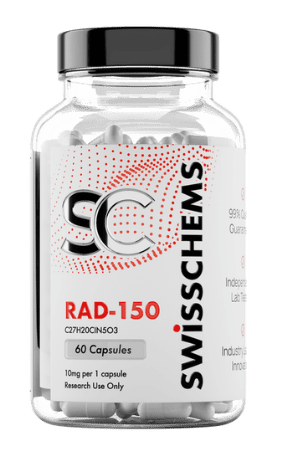



Swisschem RAD-150 is a capsule product sold under a brand name, whose label lists RAD-150 as the active ingredient. Many buyers consider RAD-150 to be an evolution of RAD-140, a well-known SARM studied in cancer research. The number in the name suggests as much. In fact, however, RAD-150 has never been studied in a laboratory in a way that has yielded published results. Everything written about the substance is based on retailer descriptions and inferences drawn from the parent compound.
This page sorts through the little that can be said. First, we show which three aspects of the claims on the bottle are unconfirmed. Then we explain how an ester is made, how medicine uses esters for other purposes, and why the concept is unlikely to work well in a capsule. We then cover laboratory testing, risks, doping tests and the legal situation. Each technical term is briefly explained when it first appears.
Three levels, three unanswered questions
With an ordinary medicine, you can rely on every detail on the packaging. Authorities have checked the manufacturer, the active ingredient and the amount. Swisschem RAD-150 lacks this assurance at every level. The table below shows what remains unverified for each claim.
| Level | What the bottle claims | What is documented |
|---|---|---|
| Brand | The product is made by Swisschem. | A brand name is not a quality seal. No authority oversees its manufacture because it is not an approved product. |
| Name | The contents are called RAD-150. | The name does not originate from a research program. There is neither a nonproprietary name nor a confirmed CAS number. |
| Molecule | It is a benzoic acid ester of RAD-140. | This structure is described this way in the marketplace. No independent structural analysis can be found in the scientific literature. |
| Quantity | Each capsule contains the stated strength. | Only an analysis of the specific batch could confirm this. |
What the name Swisschem means
A brand name mainly helps people recognize a product. It does not tell us anything more about a substance like RAD-150. For approved medicines, every batch must be released, and inspections monitor the factory. No such system exists for RAD-150, because without approval there is no regulatory oversight of its production.
The name itself does not tell us much either. A term that evokes Switzerland does not prove that the product is made there or inspected by the Swiss Agency for Therapeutic Products, Swissmedic. To the best of our knowledge, Swissmedic has never approved either RAD-150 or RAD-140. We therefore do not comment on the brand itself on this page. Instead, we describe what is and is not known about the stated contents.
How a drug substance usually gets its name
During development, new active substances are usually assigned a code made up of letters and numbers. This code is assigned by the company or institute that developed the substance. RAD140 got its name this way, too. If a candidate reaches human trials, its developers often apply to the World Health Organization for an international nonproprietary name. The name for RAD140 today is Vosilasarm.
In parallel, almost every newly described compound receives a CAS number. This is a kind of ID card for molecules, assigned by a central registry. It can be used to identify a substance unequivocally around the world, regardless of the trade name under which it appears. RAD-150 has neither. The number 150 first appeared in shops and forums, long after RAD140 had been described in scientific papers. Who assigned it is not documented. The abbreviation TLB-150, which is sometimes used alongside it, cannot be traced to any research group either.
What an ester is and what it is supposed to do
An ester forms when an acid reacts with a hydroxy group—that is, with an oxygen atom bonded to a hydrogen atom. The two parts join, releasing a water molecule. In the case of RAD-150, the acid is supposed to be benzoic acid. It would be attached to the only hydroxy group in RAD-140, which is located in a short side chain. The rest of the structure would remain unchanged.
You can think of it like a protective cover on a key. As long as the cover is on, the key probably will not fit the lock properly. Only after the body removes the cover can it unlock the door. In this analogy, the lock is the androgen receptor, a protein found in many cells that responds to male sex hormones. Certain enzymes called esterases can remove the cover. They are found in the gut and blood, and are especially abundant in the liver.
Ester prodrugs in medicine
Ester prodrugs are not uncommon in pharmaceuticals. However, it is worth noting what they are usually used for in tablets. A few examples, with their nonproprietary names, illustrate the pattern:
- Enalapril: The blood pressure medicine itself is poorly absorbed from the gut. As an ester, it enters the bloodstream more easily and is then converted into its active form in the liver.
- Oseltamivir: This flu medicine is also taken as an ester so that enough of the active substance passes through the gut.
- Valaciclovir: In this case, an attached amino acid component helps the antiviral medicine Aciclovir to be absorbed much more effectively.
For all three medicines, the ester improves absorption. A longer duration of action, by contrast, is not the goal, nor does it occur, because esterases remove the ester shortly after absorption. Each of these prodrugs is also backed by extensive studies that have measured this exact conversion. There is no such evidence for RAD-150.
Why the depot argument does not apply to capsules
Sellers often claim that RAD-150 lasts longer than RAD-140. This argument comes from injectable hormone esters. There, the ester is dissolved in oil in the muscle and enters the bloodstream only slowly. The delay therefore occurs at the injection site. A capsule does not create an oil depot like this. After swallowing, the ester immediately encounters digestive fluids and enzymes. It is therefore unlikely to noticeably extend its time in the body. In addition, according to the available data, RAD-140 already remains in the blood for a long time.
What a laboratory could test in Swisschem RAD-150
You cannot tell just by looking at a capsule whether it really contains the ester described. A specialist analytical laboratory has several tools for this, each of which answers a different part of the question.
- Mass spectrometry: It measures the mass of molecules very precisely. According to the stated structure, RAD-150 should be around 104 mass units heavier than RAD-140. If the instrument detects only the lighter parent substance, the sample does not contain an intact ester.
- Chromatography: In this separation process, substances move through a column at different speeds. A fat-soluble ester would take longer than RAD-140. This can also reveal mixtures of the two substances.
- Nuclear magnetic resonance (NMR): This method shows how the atoms in the molecule are arranged. A benzoate group leaves characteristic signals that are absent from RAD-140.
- Content analysis: Only once the identity has been established is it worth asking how much is in each capsule.
One difficulty remains. Certified reference samples are available for established active ingredients, but not for RAD-150. A laboratory can show that a molecule matches the stated structure. However, there is no official reference standard to measure it against. Studies of SARM products sold online have also repeatedly found that the label did not match the contents.
Can the ester change in the bottle?
Esters are not stable indefinitely. In the presence of moisture and heat, they can slowly break down into an acid and an alcohol—in this case, benzoic acid and RAD-140. An older or poorly stored batch could therefore contain a mixture of both substances. How quickly this happens with RAD-150 has never been measured. This illustrates why an analysis applies only to the batch tested and at the time it was tested.
The evidence on Swisschem RAD-150
There are no studies on the ester itself. What remains is a look at the parent compound that is likely to form in the body. Even then, the evidence is limited, as the comparison shows.
| Question | For RAD-150 | For RAD-140 |
|---|---|---|
| Is the structure documented in the literature? | No | Yes, with a generic name and CAS number |
| Are there cell studies? | None published | Yes, including studies on breast cancer cells |
| Are there animal studies? | None published | Yes, in rats and monkeys |
| Has the substance been tested in humans? | Never | A small Phase 1 study in women with advanced breast cancer |
| Are the long-term effects known? | No | No |
The only human study of RAD140 involved seriously ill female patients, not healthy athletes. The main finding was elevated liver enzyme levels. There are also case reports of liver damage in people who had taken RAD140 purchased online. Details are available on our RAD-140 product page. For RAD-150, this means that even in the best-case scenario—complete conversion—this limited evidence is all there is to go on.
Potential risks at a glance
Since data on the ester are lacking, risks can only be inferred. The table therefore also states the basis for each assessment.
| Risk | What it involves | Basis for the assessment |
|---|---|---|
| Liver | Elevated liver enzyme levels, potentially leading to bile stasis and jaundice | Study and case reports on RAD140 |
| Natural hormone production | The pituitary gland releases less LH and FSH, reducing testosterone and sperm production | A typical consequence of any strong androgenic signal; observed with RAD140 |
| Blood lipids | Protective HDL cholesterol can fall significantly | Measured with several SARMs and reported for RAD140 |
| Uncleaved ester | It is unknown whether some remains intact in circulation and has its own effects | Not studied |
| Benzoic acid | Released during breakdown; well tolerated in small amounts, as it is also commonly used as a preservative | General information about benzoic acid |
| Incorrect or contaminated contents | Other active ingredients, synthesis residues or different quantities | Analyses of SARM products from online retailers |
Who is at particularly high risk
- Women: Androgenic effects such as a deeper voice, increased body hair or menstrual irregularities are possible. Voice changes often do not reverse.
- Adolescents: Growth and the hormonal system are still developing, and interventions can leave lasting effects.
- Pregnant and breastfeeding women: An unborn or breastfed child is sensitive to male hormonal signals.
- People with liver disease: A liver that is already damaged is less able to cope with additional strain.
- People with heart or lipid metabolism problems: A drop in HDL can further increase an already elevated risk.
- Couples hoping to have a child: Suppressed sperm production can persist for months.
Anyone who has already taken such a substance should mention it openly at their next doctor's appointment and bring the container along. Tests for liver values, blood lipids and hormone levels are usually advisable. Yellowing of the eyes, beer-brown urine, pale stools, persistent itching or tenderness under the ribs on the right are warning signs. If these occur, seek medical attention at a clinic or emergency department without delay.
RAD-150 in competitive sport
RAD140 is listed by name on the World Anti-Doping Agency's Prohibited List; it is classified under S1.2 among anabolic agents. RAD-150 is not listed by name. However, this is not a loophole for athletes, as the list explicitly includes substances with a similar structure or effect. It is prohibited at all times, including outside competition.
The ester offers no analytical advantage either. When it is broken down in the body, RAD-140 and its metabolites are excreted, and doping laboratories look for precisely these traces. In organised sport, only the test result counts. As a rule, not knowing what was in a capsule is not a valid defence.
Legal classification in Germany
A new name or a well-known brand does not change the legal assessment. What matters is how the substance works and the purpose for which it is offered. In Germany, the situation is as follows:
- Medicinal Products Act (AMG): Because RAD-150 is intended to target the androgen receptor and thereby alter bodily functions, it is legally classified as a medicinal product. Since RAD-150 is not authorised, companies may not place it on the market.
- Food law: RAD-150 is not permitted to be marketed as a food supplement in the EU. It is neither an authorised ingredient nor approved as a novel food.
- Anti-Doping Act (AntiDopG): The annex to the Act lists SARMs as a substance group. In our understanding, esters of these substances are included as well. Anyone who deals in them for doping purposes or possesses a significant quantity for doping purposes risks prosecution.
- Import: Customs may detain suspicious shipments and refer the case to law enforcement authorities. Labels such as “for research purposes” do not change the classification.
- Switzerland: No product containing RAD-150 or RAD-140 is authorised there either. A reference to Switzerland in a brand name therefore does not confer any special status.
Frequently asked questions
Is the active ingredient in Swisschem RAD-150 different from the one in Swisschem RAD-140?
According to sellers, yes, but only slightly. RAD-150 is said to be RAD-140 with an additional benzoate group. This group would presumably be removed quickly in the body, so RAD-140 would be active again in the end.
Does the product come from Switzerland?
The brand name does not provide this information, and we make no claims about it. In any case, Swissmedic has not authorised this active ingredient.
Is RAD-150 stronger than RAD-140?
There is no evidence of this. Because the benzoate group adds weight, a capsule containing the ester actually contains slightly less of the parent compound at the same stated milligram amount. No comparative measurements have ever been published.
Does the ester act like a depot?
Hardly. A depot effect occurs with hormone esters injected in oil. A swallowed capsule does not create this depot, and enzymes in the digestive tract and liver break down esters quickly.
Can RAD-150 be distinguished from RAD-140 in a laboratory?
Yes, in principle. Mass spectrometry, chromatography and NMR can identify the additional benzoate group. However, there is no official reference standard, and an analysis says nothing about tolerability.
Is RAD-150 available by prescription?
No. Neither RAD-150 nor RAD-140 is authorised as a medicinal product anywhere, so neither can be prescribed. Anyone concerned about muscle loss, low hormone levels or performance issues can find evidence-based treatment options at a general practitioner's office or an endocrinology clinic.
Conclusion
Swisschem RAD-150 combines three unverified claims: a brand without regulatory oversight, a name with no research history and a structure described only by sellers. If the description is accurate, it is a precursor to RAD-140 that is presumably converted quickly after being swallowed. The advertised benefits, such as longer-lasting effects or greater strength, are chemically implausible and have never been measured.
The substance therefore carries the known risks of RAD-140, particularly for the liver, hormones and blood lipids. There is also uncertainty about what a particular batch actually contains. In Germany, it is not permitted to be sold as either a medicinal product or a food, and it is prohibited in sport. For questions about training, hormones or liver values, medical advice is the most reliable option.