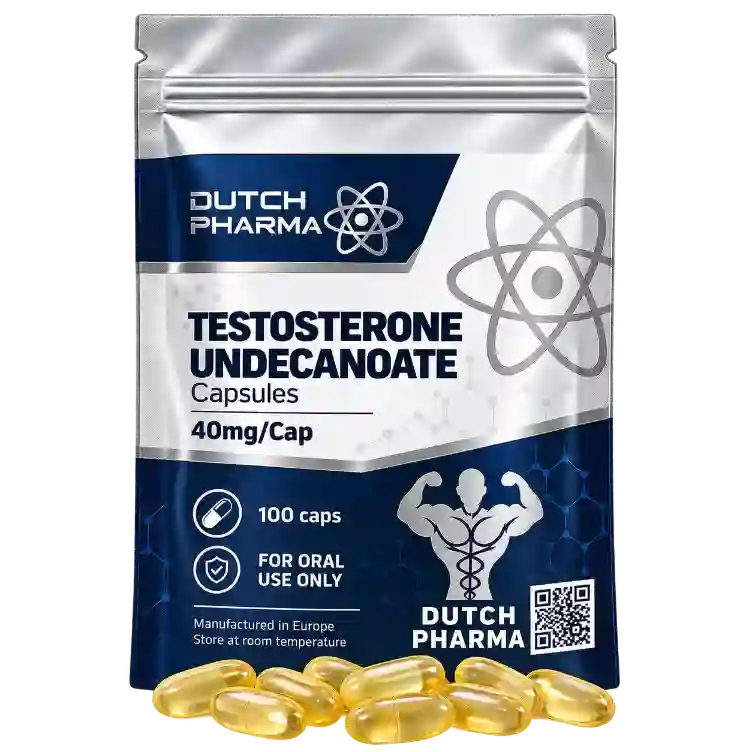




Testosterone in capsule form sounds pretty straightforward at first. Swallow it with breakfast in the morning, and that’s it. In reality, there’s a surprisingly clever pharmacological idea behind Testosterone Undecanoate Capsules 40 mg. Ordinary testosterone barely survives its journey through the stomach, intestines and liver. This capsule therefore takes a shortcut—via the lymphatic system.
On this page, we explain how this detour works and why it only works when taken with a meal. We look at the typical daily pattern of blood levels, the available research and the side effects that are most relevant to the oral form. At the end, you’ll find the legal status in Germany and answers to frequently asked questions. Everything is written so that beginners can follow along easily.
Testosterone Undecanoate Capsules at a glance
- Active ingredient: Testosterone undecanoate, dissolved in an oily filling
- Amount: 40 mg ester per softgel, equivalent to about 25 mg testosterone
- Key feature: Absorbed primarily via the lymphatic vessels rather than the portal vein
- Requirement: Take with a meal containing some fat
- Duration of action: only a few hours, so multiple doses are taken throughout the day
- Status in Germany: Prescription-only medicine and a doping agent under the AntiDopG
Why ordinary testosterone doesn’t work as a tablet
To understand the capsule, it helps to take a quick look at digestion. Almost everything we swallow first travels from the intestine to the liver via the portal vein. Only then does it reach the rest of the body. Experts call this the first-pass effect. The liver acts as a very thorough checkpoint.
When it comes to unchanged testosterone, it is even too thorough. Its enzymes break down the hormone almost completely during the first pass. So if you swallowed pure testosterone, hardly any would reach the bloodstream.
For a long time, there were only two oral alternatives. One was methyltestosterone, which is testosterone with an additional methyl group at position 17α. This small change protects the molecule from being broken down in the liver. However, it places considerable strain on the organ and can cause liver damage in the worst cases. The other alternative was to avoid swallowing it altogether and inject testosterone. Testosterone undecanoate in capsule form was the first serious third option.
The detour via the lymphatic system
The trick relies on a property of dietary fat. In the small intestine, fats are not released directly into the blood like sugars or proteins. Instead, intestinal cells package them into tiny transport particles called chylomicrons. These are too large to pass through the tiny blood vessels in the intestinal wall, so they enter the lymphatic vessels instead.
From there, the lymph flows through a large collecting duct, the thoracic duct (Ductus thoracicus), toward the heart. Just before reaching the heart, it empties into a vein. This route initially bypasses the liver.
Because of its long fatty acid chain, testosterone undecanoate is extremely fat-soluble. In intestinal cells, it therefore behaves similarly to a fat molecule and travels in part with the chylomicrons. Only once it reaches the blood do enzymes cleave off the undecanoic acid and release the testosterone itself.
Why the meal matters
Without dietary fat, the intestine produces hardly any chylomicrons. The transport vehicle is then missing, and most of the active ingredient is carried to the liver via the portal vein and broken down there. This is not just a theory; it is well established.
A 2003 study by Bagchus and colleagues compared absorption when fasting and after different meals. On an empty stomach, testosterone levels remained almost unchanged. A regular breakfast containing around 19 grams of fat, however, led to a significant increase in absorption. A follow-up study by Schnabel and colleagues (2007) showed that eating even fattier food provided no meaningful additional benefit. An ordinary meal is enough. An extra-fatty meal offers few advantages.
What the 40 mg actually means
The pack says 40 mg. However, a large portion of this is accounted for by the undecanoic acid. In numerical terms, each capsule delivers only about 25 mg of testosterone. And only a small fraction of that reaches the bloodstream. Depending on the study, oral bioavailability is in the range of a few percent.
That may sound wasteful, but it is intentional. The amount of active ingredient per capsule is chosen so that measurable hormone levels are achieved despite the low yield. At the same time, the low percentage explains why even small differences in food, digestion or gut health can noticeably shift levels.
Daily pattern: short waves instead of a depot
A depot injection releases its active ingredient over several weeks. With the capsule, it is exactly the opposite. After taking it, testosterone levels rise within a few hours. The peak usually occurs about four to five hours after swallowing the capsule. Levels then fall again, and after around eight to twelve hours they return to baseline.
The result is a pattern of several small waves per day. This has advantages and disadvantages. On the one hand, the active ingredient quickly disappears from the body if treatment is stopped. On the other hand, it is difficult to achieve steady levels.
There is also considerable variability. Two men who take the same capsule with the same meal can reach very different levels. Even in the same person, levels can vary from day to day. Studies of older capsule formulations report that some patients remained below the normal range despite taking them.
High DHT: a feature of the capsule form
In the body, testosterone is partly converted into dihydrotestosterone (DHT) by the enzyme 5α-reductase. DHT has a stronger effect on hair roots, skin and the prostate. With the capsule, this conversion happens very early, namely in the intestinal wall itself. Dihydrotestosterone undecanoate is produced there and is also absorbed via the lymphatic system.
Measurements therefore show a higher DHT-to-testosterone ratio with oral administration than with injections or gels. The clinical significance is not yet fully understood. However, the question is relevant for the prostate, skin and hair, and doctors take it into account when selecting a form of therapy.
A brief history of the testosterone capsule
The oral form is the oldest use of testosterone undecanoate. The first capsule came onto the market in Europe in the late 1970s. At the time, the active ingredient was dissolved in oleic acid. This formulation was sensitive and had to be refrigerated until it was dispensed by the pharmacy. After that, it had only a limited shelf life at room temperature.
A revised formulation followed in the early 2000s. Since then, a mixture of castor oil and propylene glycol monolaurate has been used instead of oleic acid. This makes the capsule stable for longer at room temperature, making everyday use easier for patients.
Oral testosterone undecanoate was long unavailable in the United States. It was not until 2019 that the FDA approved a new capsule, with others following. These modern formulations use self-emulsifying systems intended to make absorption more reliable. However, approval came with a prominent warning. In long-term blood pressure monitoring, blood pressure rose in many participants taking it. Read more in the section on side effects.
Capsule, gel or depot: a direct comparison
There are now several dosage forms available for testosterone therapy. The following table compares the key differences.
| Feature | Undecanoate capsule | Testosterone gel | Undecanoate depot |
|---|---|---|---|
| Use | Swallow with food | Apply to the skin | Injection into the muscle |
| Frequency | Several times daily | Once daily | Every few weeks to months |
| Level profile | Several short peaks per day | Relatively steady | Slower rise, prolonged decline |
| Stopping treatment | Effect wears off within hours | Effect wears off within days | Cannot be reversed; effects last for weeks |
| Typical drawback | Highly variable absorption | Transfer to others through skin contact | Rare oil microembolism after injection |
No form is inherently better. The right option depends on health, lifestyle and personal preferences.
When doctors prescribe the capsules
Testosterone undecanoate capsules are approved for men with a confirmed testosterone deficiency, known as hypogonadism. Confirmed means there are typical symptoms and several morning blood tests show clearly low levels. Doctors also often investigate the cause, such as a disorder of the testes or pituitary gland.
In practice, doctors mainly use the oral form in the following situations:
- when injections are not wanted or not possible, for example in the case of a blood-clotting disorder
- when a gel is unsuitable because of skin irritation or close contact with children
- when treatment needs to be stopped quickly at any time
- occasionally in specialist centers for delayed puberty, when a low dose that can be carefully adjusted is desired
The treating doctor always determines how many capsules to take and when. This is based on lab results, symptoms and how the condition progresses.
What studies say about efficacy and safety
Data on the capsules spans more than four decades. In men with a deficiency, they measurably improve libido, sexual function and well-being. Bone density and muscle mass may also benefit, although often less noticeably than with forms that produce more stable levels. One important reason is the fluctuating absorption mentioned above.
The newer American formulations were tested according to stricter criteria. In their approval studies, the average daily level was within the normal range for most participants. However, these studies generally lasted only a few months. Reliable data over many years, for example on the heart and blood vessels, are not yet available for these preparations.
The capsules have never been studied for competitive sports or muscle building in healthy people. Claims on forums are based on individual reports and cannot be evaluated scientifically.
Possible side effects of the oral form
The capsule shares many potential side effects with every other testosterone treatment. However, some issues are a particular focus with oral administration.
Stomach and intestines
Because the active ingredient is absorbed in the digestive tract, some users report abdominal pain, nausea, diarrhea or belching. These symptoms are usually mild. They are rarely an issue with injections or gels.
Blood pressure
Blood pressure measurements from the US approval studies have brought this issue to the fore. On average, readings increased by a few mmHg, with a greater increase in some participants. Even small, sustained increases raise the long-term risk of heart attack and stroke. Regular measurements, including at home, are therefore part of monitoring.
Blood count
Testosterone causes the bone marrow to produce more red blood cells. If the hematocrit rises too high, blood flows more sluggishly and the risk of thrombosis may increase. This effect is somewhat less pronounced on average with the capsule than with injections, but it can still occur.
Hormonal feedback and fertility
When testosterone comes from an external source, the body registers that levels are sufficiently high. In response, the pituitary gland reduces the production of the messengers LH and FSH. The testes then produce less testosterone of their own and fewer sperm. This is an important consideration for men who want to have children and should be discussed with a doctor before starting treatment.
Skin, hair, prostate and breasts
Acne, oily skin and worsening hereditary hair loss are possible. The high DHT content means the prostate requires particular attention. Some testosterone is also converted into estradiol, which can rarely cause breast tenderness or enlargement of the breast gland.
Other effects
Fluid retention, mood swings and worsening of existing sleep apnea have been reported. Compared with 17α-alkylated steroids, testosterone undecanoate places little strain on the liver. However, changes in liver values cannot be ruled out entirely.
Interactions with other medicines
A capsule can also affect other medicines. The following interactions are particularly well known:
- Blood thinners of the coumarin type: Testosterone can enhance their effects, so coagulation values are monitored more frequently.
- Insulin and other diabetes medicines: Insulin sensitivity may change, requiring adjustments to blood sugar management.
- Cortisone and similar active ingredients: The tendency to retain fluid may increase.
Anyone taking other medicines or dietary supplements should always mention this to their doctor.
When the capsules are not suitable
There are clear situations in which doctors advise against testosterone therapy. These include prostate cancer and breast cancer in men, current or previous liver tumors, and elevated calcium levels associated with cancer. Caution is also required in cases of severe heart failure, untreated sleep apnea, very high hematocrit and poorly controlled high blood pressure.
This medicine is not intended for women. During pregnancy, testosterone can cause a female unborn baby to develop male characteristics. In children and adolescents, it may be used only under specialist medical supervision, as it can cause growth to stop prematurely. There is also a practical detail: the capsule shell is generally made of gelatin. This may be a concern for people who avoid animal products.
Monitoring during treatment
With the oral form, the timing of the blood test is particularly important. Because levels rise and fall significantly throughout the day, the result depends on how long ago the last capsule was taken and the last meal was eaten. The doctor will therefore usually specify exactly when the test should be done. The following values are typically monitored over time:
- Testosterone, and, if needed, free testosterone and SHBG
- Hematocrit and hemoglobin
- Blood pressure, ideally including self-measurements
- PSA level and prostate examination from a certain age onward
- Blood lipids and liver function tests
In the first few months, check-ups are usually more frequent. If levels remain stable, the intervals are extended.
Capsules and doping tests
Testosterone is prohibited in all its forms on the World Anti-Doping Agency (WADA) Prohibited List, under Group S1. The fact that the effects of a capsule wear off after a few hours does not make it undetectable in tests. Laboratory analyses look, for example, at the ratio of testosterone to epitestosterone in urine. Isotope-ratio mass spectrometry (IRMS) can also reveal whether a hormone was produced naturally in the body or came from an external source. In addition, the Athlete Biological Passport tracks changes over time. Anyone competing in sport who needs testosterone for medical reasons requires a Therapeutic Use Exemption (TUE) approved in advance.
Legal classification in Germany
The same rules apply to this capsule as to any other testosterone preparation. Under the German Medicinal Products Act (AMG), it is a medicinal product. According to the German Medicinal Products Prescription Ordinance (AMVV), it may only be dispensed by a pharmacy on a doctor's prescription. Obtaining it without a prescription for personal use is therefore not permitted.
The German Anti-Doping Act (AntiDopG) also applies. Its annex lists testosterone as a doping substance. It is a criminal offence to manufacture, market, supply or administer such substances to others for doping purposes. Buying or possessing a non-insignificant quantity for such purposes is also punishable. The relevant thresholds are set out in the German Doping Substances Quantity Ordinance. For elite athletes taking part in organised competitions, even using it on themselves is prohibited.
Frequently asked questions about testosterone undecanoate capsules
Can the capsule be opened or chewed?
The manufacturer advises swallowing the soft capsule whole with a little liquid. The oily filling is part of how it is absorbed. If released prematurely, it may behave differently in the intestine.
Is a glass of water enough instead of a meal?
No. Without dietary fat, the chylomicrons that transport the active ingredient are absent. Studies show that very little testosterone reaches the blood when taken on an empty stomach. However, an ordinary meal is sufficient.
Is this capsule the same as methyltestosterone?
No. Methyltestosterone is chemically modified so that the liver cannot break it down, placing considerable strain on the organ. Testosterone undecanoate, by contrast, remains a conventional ester. It bypasses the liver not through a molecular modification, but via the lymphatic system.
Why do my lab results fluctuate so much?
Because absorption depends on many factors: the fat content of the meal, the time between eating and taking the capsule, digestion and individual differences in metabolism. For this formulation, a single measurement is therefore less informative than it is for a depot preparation.
Does the capsule have anything in common with the depot injection?
Only the active ingredient. Absorption, blood level patterns, side-effect profile and administration differ fundamentally. Data on the injection therefore cannot be applied to the capsule, or vice versa.
How quickly does the active ingredient leave the body after stopping?
Very quickly. By the day after the last capsule, levels are back in the baseline range. However, the body's own production often takes longer to stabilise again.
Conclusion: a clever idea with some trade-offs
Testosterone undecanoate 40 mg capsules offer an elegant solution to a longstanding problem. Instead of chemically shielding the molecule from the liver, they carry it into the bloodstream through the lymphatic vessels along with dietary fat. This spares the liver and makes treatment without injections possible, with effects that can be stopped quickly at any time.
The downsides are a short duration of action, several doses a day and markedly fluctuating blood levels. There is also a high DHT component and the possibility of increased blood pressure, which should be checked regularly. In Germany, the capsule is available only on prescription and is classified as a doping substance. Anyone experiencing symptoms of testosterone deficiency is best advised to consult a urology or endocrinology practice.