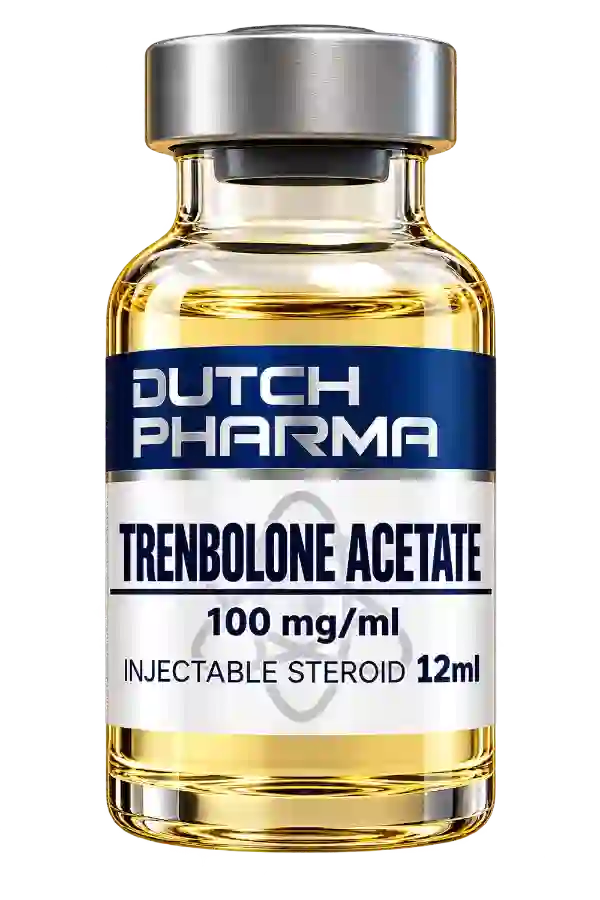


Trenbolone Acetate 100 has an unusual origin. The active ingredient was not developed for clinics or medical practices, but for livestock farms. To this day, cattle in some countries receive small implants behind the ear that slowly release trenbolone acetate. This steroid, however, has never been approved for use in humans. Nevertheless, it is one of the most discussed substances in the strength sports scene.
In this guide, we take a look at what lies behind the name. You’ll learn how trenbolone is structured chemically and why it differs significantly from testosterone. We’ll then cover the available research, known risks and the legal situation in Germany. We explain technical terms directly in the text, so you can follow along without any prior knowledge.
What is Trenbolone Acetate 100?
Trenbolone is a fully synthetic steroid, which means the body does not produce it itself. Chemically, it belongs to the so-called 19-nortestosterone derivatives, making it a distant relative of nandrolone. “19-nor” means that a carbon atom is missing from a particular position in the basic structure. This small change affects how the molecule is processed in the body.
In acetate, an acetic acid residue is attached to trenbolone. Experts call this an ester. It makes the molecule slightly more fat-soluble and thus delays its release from the muscle depot. With just two carbon atoms, however, acetate is one of the shortest esters. Accordingly, its effects last only a short time.
The number 100 refers to the concentration: 100 mg of trenbolone acetate per milliliter of oil. Once the ester portion is subtracted, around 87 mg of pure trenbolone remains by calculation. The rest is the acetic acid group, which is rapidly cleaved in the blood.
Key points at a glance
- Trenbolone originates in veterinary medicine and was intended as a growth promoter for cattle.
- There is no approved medicine containing trenbolone acetate for human use.
- The molecule is not converted into estrogen, but it does bind to the progesterone receptor.
- There is almost no reliable research in humans.
- In Germany, trenbolone is explicitly included on the list under the Anti-Doping Act.
From the research lab to the cattle barn
The history of trenbolone began in the 1960s. At the time, pharmaceutical companies in France were looking for steroids that would help animals build muscle mass more quickly. The aim was to improve the feed-to-meat ratio. Trenbolone acetate proved particularly effective in these trials, and in the 1970s it came onto the market as an implant for cattle raised for meat.
In the US, Canada and some other countries, such implants are still common practice. They are often combined with an estrogen. Europe took a different approach. Since 1988, the European Community has prohibited hormonally active substances used to boost the performance of livestock. This ban was later reaffirmed in Directive 96/22/EC. It applies not only to domestic livestock farming, but also to imported meat.
This sparked one of the best-known trade disputes of the 1990s. The US and Canada challenged the European ban on hormone-treated meat imports before the World Trade Organization. The dispute lasted for many years and shows how differently authorities assess residues of these active substances.
Was a human medicine ever available?
For the acetate, the answer is clearly no. Only another, long-acting trenbolone ester was briefly available for human use in France during the 1980s and 1990s. The manufacturer withdrew it from the market in 1997. Since then, there has been no approved human medicine based on trenbolone anywhere in the world. Anything circulating today outside veterinary medicine comes from uncontrolled sources.
A molecule with three double bonds
A look at trenbolone’s structural formula reveals three double bonds in its ring system. Testosterone has only one. This particular feature gives the molecule its rigid shape. It also determines which enzymes can act on trenbolone and which cannot.
Two effects are particularly important for understanding this:
- No conversion to estrogen: The enzyme aromatase cannot convert trenbolone into an estrogen. By contrast, this happens constantly with testosterone.
- No enhancement by 5α-reductase: In the skin and prostate, testosterone is converted into the stronger hormone dihydrotestosterone (DHT). Trenbolone is not a suitable substrate for this enzyme.
This often leads to the conclusion that trenbolone is “cleaner” than testosterone. However, this conclusion is too simplistic. The absence of a conversion pathway does not mean there are no side effects. It only means they arise through other mechanisms. More on that shortly.
How trenbolone works in the body
After injection, trenbolone acetate moves from the oil depot into the bloodstream. There, enzymes known as esterases remove the acetate group. What remains is free trenbolone. It spreads through the tissues and binds to various receptors.
The androgen receptor
The androgen receptor is central. It is found in muscle cells, bones, skin, hair follicles and many other tissues. Laboratory studies show that trenbolone binds very tightly to this receptor, much more tightly than testosterone. Once activated, the receptor switches on genes in the cell nucleus that, among other things, promote the production of muscle protein.
The progesterone receptor
Less well known is that trenbolone also activates the receptor for the hormone progesterone. This so-called progestogenic potential contributes to strongly suppressing the body’s own hormone production. Whether it also affects breast tissue or prolactin levels has barely been studied in humans. Discussion of this is based mainly on theory and anecdotal reports.
Effect on stress hormones
The assumption that trenbolone weakens the effects of cortisol in muscle comes from studies in cattle. Cortisol is a stress hormone that breaks down protein. Researchers also found increased production of the growth factor IGF-1 in muscle cell cultures. How well these findings apply to humans remains unclear.
Comparison with related substances
| Feature | Testosterone | Nandrolone | Trenbolone |
|---|---|---|---|
| Origin | Naturally occurring hormone | Synthetic | Synthetic |
| Conversion to estrogen | Yes | Low | No |
| Conversion by 5α-reductase | Yes, to DHT | Yes, to the weaker DHN | No |
| Binding to the progesterone receptor | Minimal | Yes | Yes |
| Approved for human use | Yes | Yes, in some countries | No |
What the acetate ester means for pharmacokinetics
Pharmacokinetics describes how quickly a substance enters the bloodstream and then disappears. With acetate, this happens quickly. Because the acetic acid group is so small, the molecule leaves the oil depot rapidly. Levels rise within a short time and drop significantly again after a few days.
There are no precise figures for humans, however. The often-quoted half-life of one to three days is based on veterinary data and comparisons with other acetate esters. In beef cattle, incidentally, injection plays hardly any role. The active ingredient is contained in a solid pellet under the skin, which releases it steadily over several weeks.
For the purposes of understanding, this mainly means one thing: pronounced fluctuations in blood levels are typical of such a short ester. These peaks and troughs place additional strain on the hormonal balance and make the effects difficult to predict.
How well has trenbolone been studied?
This is one of the most important points in this article. Almost everything science knows about trenbolone comes from animal research. For beef production, weight gain, feed efficiency and residues in meat have been measured extensively. The safety of use in humans, by contrast, was never assessed in a clinical approval study.
There are also studies in rats. For example, a research group in Florida observed that trenbolone preserved muscle and bone mass in castrated rats, while the prostate barely grew. Such results are of interest for basic research. However, they cannot be readily applied to humans, especially not to amounts commonly used outside of medicine.
Human data are largely limited to case reports and surveys. These describe patients who came to the clinic with health problems and had used trenbolone. They often took other substances at the same time, making it difficult to attribute individual effects with certainty. Nevertheless, these reports paint a fairly consistent picture of the risks.
Known health risks
The following sections summarize what studies and medical case reports show about trenbolone and related steroids. This list is not exhaustive. However, it makes clear why professional associations issue particularly strong warnings about this substance.
Heart and blood vessels
Anabolic steroids alter blood lipids. A typical effect is a significant drop in “good” HDL cholesterol, while “bad” LDL may rise. This effect is described as particularly pronounced with 19-nor compounds such as trenbolone. Over the long term, this pattern encourages deposits to build up in the blood vessels.
There are further risks, too. Imaging studies of long-term steroid users more often show thickened heart muscle and impaired pumping function. Blood pressure may rise, as may the proportion of red blood cells. Medical literature includes case reports of heart failure, heart attacks and blood clots in young men who had used trenbolone, among other substances.
Mental health and the nervous system
Few other steroids are associated with psychological changes as often. In surveys, users report irritability, aggression, restlessness, anxiety and severe sleep disturbances. Some also describe periods of depression, especially after stopping.
Animal studies support these observations. Rats given Trenbolone showed increased aggressive behavior in several studies. In cell culture experiments, Trenbolone also triggered programmed cell death in nerve cells. What this means for the human brain is not yet clear. However, the findings are a serious warning sign.
Hormonal Axis and Fertility
The brain controls hormone production through the messengers LH and FSH. When it detects high levels of androgens and progestogens, it suppresses these signals. Trenbolone does this very effectively. The testes then produce very little testosterone of their own and fewer sperm. They can shrink, and fertility declines.
Recovery time varies greatly from person to person. Some men’s levels return to normal after a few months. Others suffer from hormone deficiency for a long time, with fatigue, loss of libido and low mood.
Kidneys and liver
Trenbolone acetate is not 17α-alkylated. That is the chemical modification that places a heavy burden on the liver with many steroid tablets. A lower risk to the liver does not mean zero risk. In addition, case reports describe kidney damage in steroid users, such as scarring of the glomeruli. Very high protein intake and blood pressure are thought to play a role.
Other commonly reported complaints
- Skin and hair: Acne, oily skin and accelerated hair loss in people with a predisposition.
- Coughing after injection: A brief, severe coughing fit is frequently reported. The cause is unclear.
- Night sweats: Many users report heavy sweating, especially during sleep.
- Breathing and endurance: Some notice a significant reduction in exercise capacity during endurance training.
- In women: A deeper voice, facial hair growth, menstrual irregularities and enlargement of the clitoris. These changes can be permanent.
Additional risks from unregulated sources
Since no regulated human preparation exists, injectable Trenbolone is not subject to official quality control. Tests of seized steroids repeatedly reveal incorrect amounts of active ingredients, foreign substances or microbial contamination. The result can be injection abscesses and infections, which are regularly seen in emergency departments.
Three common misconceptions
A number of claims about Trenbolone do not stand up to closer scrutiny.
Myth 1: “Without aromatization, breast development cannot occur.” Since Trenbolone also activates the progesterone receptor and shifts the overall hormonal balance, this cannot be stated as a blanket rule. In addition, other steroids are often taken at the same time.
Myth 2: “If animals tolerate it well, it must also be harmless to humans.” Beef cattle receive the drug for a few months until slaughter. Long-term effects therefore do not matter in livestock farming. These experiences say nothing about its safety for humans.
Myth 3: “A short ester leaves the body quickly, so the side effects do too.” The ester only determines how quickly the active ingredient enters the bloodstream. Changes to the heart, blood vessels or hormonal axis can persist much longer.
Trenbolone in the environment
One aspect that is rarely discussed concerns rivers and lakes. Cattle excrete some Trenbolone as a breakdown product, primarily as 17α-Trenbolone. It enters waterways through manure and wastewater from large-scale feedlots. As early as the early 2000s, US researchers showed that even tiny amounts can disrupt reproduction in fish and cause female fish to develop male characteristics.
Later studies found that certain breakdown products in water can partially revert when exposed to sunlight. As a result, their hormonal effects last longer than originally assumed. For environmental authorities, Trenbolone is therefore an example of how veterinary medicines can have effects far beyond the farm.
Trenbolone in sport and doping tests
The World Anti-Doping Agency (WADA) lists Trenbolone in Group S1 of prohibited substances. This means it is prohibited both in and out of competition. Laboratories detect Trenbolone and its metabolites in urine using modern methods such as mass spectrometry.
Athletes with positive test results repeatedly claim that they consumed contaminated meat from abroad. In Europe, such explanations are not very plausible in the case of Trenbolone, because hormone-treated beef may not be sold here at all. Anti-doping tribunals examine each case individually, but rarely accept this argument.
Legal status in Germany
In Germany, Trenbolone is covered by several sets of regulations. They concern people, sport and agriculture.
Medicinal Products Act (AMG)
In Germany, a medicinal product may generally only be placed on the market if it has been authorized. There is no human medicinal product containing Trenbolone. Anyone who nevertheless manufactures or distributes such a product violates the authorization requirement under the AMG. Depending on the case, the prohibition on so-called medicinal products of concern may also apply. Violations are punishable by law.
Anti-Doping Act (AntiDopG)
Trenbolone is specifically listed in the annex to the Anti-Doping Act. This makes any transfer for doping purposes a criminal offense, whether by manufacturing or selling it, or injecting it into another person. For personal use, the law sets a quantity threshold: anyone who possesses or obtains more than the prescribed limit also commits a criminal offense. The exact thresholds are set out in the Doping Agents Quantity Ordinance.
Veterinary medicinal products and food law
In agriculture, the EU-wide ban on hormones to promote growth, which has been implemented in German national law, applies. Residues in food are regularly monitored as part of the National Residue Control Plan. To the best of our knowledge, no veterinary medicines containing Trenbolone are approved in Germany.
Frequently asked questions about Trenbolone Acetate 100
Why is the product called “Trenbolone Acetate” and not “Trenbolon Acetat”?
Both refer to the same substance. “Trenbolone Acetate” is the internationally common English name. In German, it is usually written as Trenbolonacetat or Trenbolon Acetat.
Do doctors in Germany prescribe Trenbolone?
No. Since there is no approved medicine for human use, Trenbolone is not available for medical treatment. For hormone deficiencies, specialists use approved testosterone products.
Why is the solution often yellowish?
Trenbolone itself has a yellowish color. This is due to its system of three double bonds, which absorbs some of the light. The color says nothing about its quality or purity.
Can Trenbolone be measured in blood?
Specialized laboratories, such as those involved in doping analysis, can detect Trenbolone. This is not part of the routine tests performed at a general practitioner’s office. Health indicators such as blood lipids, blood count, kidney and liver values, and the body’s own hormones are more important there.
Who can I contact if I have questions or concerns?
Your first point of contact should be your general practitioner or an endocrinology practice. Doctors are bound by professional confidentiality. Many cities also offer counseling services that provide confidential, nonjudgmental information on medication and doping-related questions.
Conclusion
Trenbolone acetate is an active substance used in animal fattening that has never been tested or approved for human use. Its chemistry clearly differs from that of testosterone: it is not converted into estrogen or DHT, but it binds strongly to the androgen and progesterone receptors. These properties do not make it safer; they merely shift the risks.
The available data point to considerable strain on the heart, blood vessels, mental health, and hormone balance. At the same time, there are few studies in humans, which makes any assessment even more uncertain. In Germany, Trenbolone is listed under the Anti-Doping Act and cannot legally be marketed as a medicinal product. Anyone considering this topic should discuss their questions with a doctor.