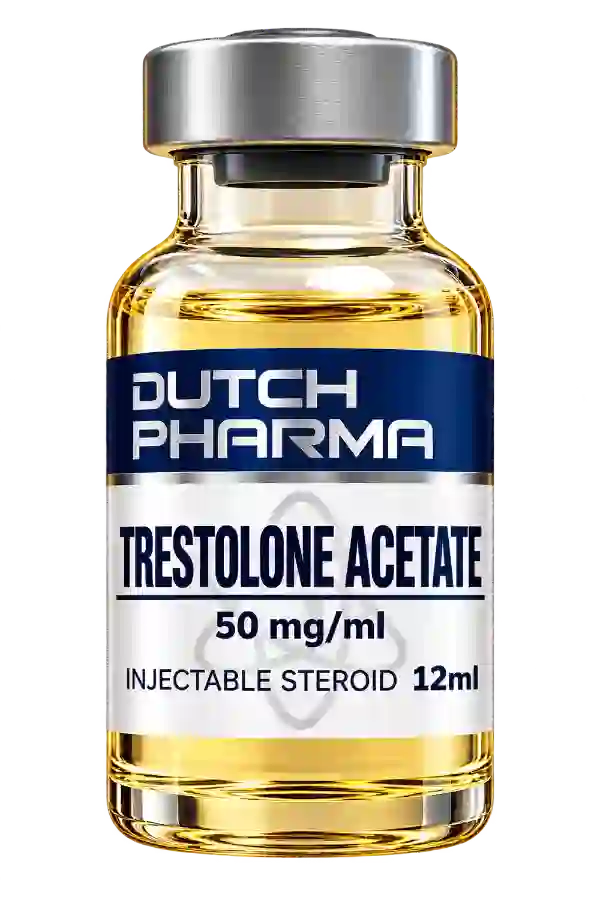


Trestolone Acetate 50 has a history you would hardly expect from a steroid. The active ingredient was originally intended not to build muscle, but to solve a family-planning problem. Researchers were looking for a hormone that could provide men with reliable, reversible contraception. For many years, trestolone, usually called MENT in scientific literature, was considered a promising candidate for this purpose.
Today, the same substance appears on the black market as an oily injectable solution. There is a wide gap between these two worlds. The studies focused on small implants under the skin, not injections. This article explains what trestolone is, what research has actually found, and why the project never became a medicine. It concludes with potential health risks and an overview of German law.
What is trestolone acetate?
Trestolone is a synthetic steroid hormone. Chemically, it belongs to the 19-nor steroid family. Compared with the body’s own testosterone, its structure lacks a methyl group at position 19. Nandrolone is the best-known member of this group.
Trestolone also has a small methyl group at position 7 of the molecule. This is where the long chemical name 7α-Methyl-19-nortestosterone, abbreviated to MENT, comes from. As we will see below, this tiny change has surprisingly significant effects on metabolism.
In acetate, a very short acid chain is attached to the hormone. This makes the molecule more soluble in oil and slightly delays its release. Enzymes rapidly cleave the chain in the body. Free trestolone is then left behind. Of the 50 milligrams per milliliter stated on the label, approximately 43 to 44 milligrams are attributable to the hormone itself. The rest is the weight of the acetate group.
- Trestolone was first synthesized in the 1960s.
- From the 1990s onward, a nonprofit research organization further developed it as a contraceptive for men.
- Research focused mainly on an implant that releases the active ingredient steadily over several months.
- An injectable solution at 50 mg/ml was never part of an official development program.
- Trestolone has never been approved as a medicine in any country.
The idea: contraception for men
To understand why this particular steroid was studied, it helps to take a brief look at hormonal regulation. The testes produce testosterone and sperm only when they receive signals from the pituitary gland. These signals are called LH and FSH. When male hormone levels in the blood rise sharply, the brain reduces both messengers. The testes then receive no instructions and largely stop functioning.
Researchers wanted to use exactly this mechanism for contraception. An externally administered androgen was intended to suppress sperm production while maintaining male bodily functions. This principle works with regular testosterone too, but it requires relatively large amounts. Over time, these put strain on the prostate and other organs.
Trestolone seemed to offer a way around this. In animal studies, it had several times the effect of testosterone on muscle and hormonal regulation. By contrast, the prostate responded relatively weakly. Researchers therefore hoped that a small amount, steadily released by an implant, would be sufficient. A single minor procedure on the upper arm could then last for many months.
What the clinical trials showed
Human research was limited to a few relatively small studies. They were conducted mainly around the turn of the millennium in Europe, South America, and the USA. Almost all used implants made of a flexible plastic that slowly released trestolone acetate. This is important because this form is fundamentally different from an oil injection.
Contraception studies
In a study published in 2003, 35 healthy men received either one, two, or four implants. The more implants they received, the higher their trestolone levels rose and the more their testosterone, LH, and FSH levels fell. Sperm counts also decreased depending on the dose. However, this effect was largely absent at the lowest dose.
The results showed that the principle could work. But they also highlighted the challenges. Sperm counts did not reliably fall below the threshold needed for safe contraception in all participants. This reliability is crucial for a contraceptive.
Studies on hormone replacement
At the same time, researchers investigated whether trestolone could help men with low testosterone. They compared implants with conventional testosterone therapy. According to published data, sexual function and mood were maintained equally well. However, these studies were also small and lasted only a few months. They do not provide any information about safety with long-term use.
Why it was never approved
The public sources do not point to a single reason for its discontinuation. Several factors came together. Sperm suppression was insufficient in some men. Developing an implant through to market is expensive, and large pharmaceutical companies showed little interest in male contraception overall. There were also unanswered questions about its effects on blood lipids and bones. The program was eventually discontinued.
How trestolone works in the body
Like all androgens, trestolone binds to the androgen receptor. This receptor is found in muscle cells, skin, bones, the brain, and many other tissues. When activated, it changes which genes the cell reads. In muscle, this includes increased protein synthesis. The hormone also acts on the brain, suppressing the release of LH and FSH.
No conversion by 5α-reductase
In some organs, the enzyme 5α-reductase converts natural testosterone into the more potent dihydrotestosterone. This happens especially in the prostate, scalp, and skin. Trestolone’s methyl group blocks this step. As a result, the substance does not have an additional amplifying effect in the prostate, which was considered an advantage in animal studies. Whether this holds true in humans over the long term was never adequately investigated.
Conversion into a potent estrogen
Unlike many other 19-Nor steroids, trestolone is converted into an estrogen by the enzyme aromatase. This produces 7α-Methylestradiol. This estrogen is highly potent. This was actually desirable in the studies, because estrogens are also important for men, for example for bone health and fat metabolism. At higher doses, however, the estrogen component can cause problems such as enlargement of the breast gland.
Little binding to SHBG
In the blood, much of the testosterone is bound by a transport protein called SHBG. Trestolone binds to it only very weakly. As a result, a greater proportion remains free and therefore active. This partly explains why the substance has a strong effect even in small amounts. However, it also means that it is broken down quickly.
| Feature | Testosterone | Nandrolone | Trestolone (MENT) |
|---|---|---|---|
| Basic structure | Endogenous androgen | 19-Nor steroid | 19-Nor steroid with a 7α-methyl group |
| 5α-reduction | Yes, to DHT | Yes, to a less potent substance | No |
| Aromatization | Yes, to estradiol | Low | Yes, to 7α-methylestradiol |
| Binding to SHBG | Strong | Moderate | Very weak |
| Approved for human use | Yes | In some countries | No, studies only |
Implant and injection: a big difference
This is a point worth looking at closely. Free trestolone has a very short half-life. Half-life is the time it takes for half of a substance in the blood to be broken down. For trestolone, it ranges from minutes to a few hours. That is exactly why researchers used an implant that continuously releases small amounts.
An oil-based injection works differently. The short acetate ester extends release only to a limited extent. After an injection, levels therefore presumably rise sharply and then fall rapidly again. There are no reliable measurements of this, because this form has never been systematically studied in humans. All claims about how long a trestolone acetate injection lasts are based on estimates and anecdotal reports from online forums.
These reports often mention painful injection sites. Short esters are generally considered irritating to tissue, and products made without proper quality control also raise concerns about solvents and sterility. This has not been scientifically tested either.
Potential risks and side effects
Because trestolone was never approved, there is no complete list of side effects like the one found in a package leaflet. What is known comes from short studies with few participants and general knowledge about potent androgens. The points below are therefore not exhaustive.
Hormonal system and fertility
Suppressing the body’s own hormone production is not a side effect of trestolone; it is the effect it was developed to produce. The testicles can shrink, and sperm production can come almost to a halt. In the studies, levels usually recovered after the implants were removed. How quickly and completely this happens after longer or higher exposure remains unknown. After discontinuation, a pronounced hormone deficiency may occur temporarily, with fatigue, lack of motivation, and low mood.
Estrogen-related effects
Because it is converted into 7α-Methylestradiol, estrogen-related side effects are possible. These include fluid retention and enlargement of the male breast gland, known as gynecomastia. There is also evidence that Trestolone acts on the progesterone receptor. This could intensify these effects.
Heart, blood vessels and blood
Potent androgens often lower “good” HDL cholesterol. Changes in blood lipids have also been observed in studies of Trestolone. In addition, androgens stimulate the production of red blood cells. If this makes the blood too viscous, the risk of thrombosis increases. Blood pressure may also rise. Together, these factors can place long-term strain on the heart and blood vessels.
Skin, mental health and other organs
- Acne and oily skin, because the sebaceous glands respond to androgens
- Irritability, sleep problems or mood swings
- Masculinization in women, such as a deeper voice, increased body hair and menstrual irregularities, some of which may be permanent
- Premature closure of growth plates in adolescents
- Infections or abscesses at the injection site due to unclean preparation
Unknown long-term effects
Perhaps the most important point is what nobody knows. No study has followed people for many years. The effects on the liver, kidneys, bones or cancer risk therefore cannot be assessed reliably. For an approved medication, these questions would have been resolved before it came onto the market. With Trestolone, they remain unanswered.
What is unknown about products available today
In the studies, Trestolone acetate came from controlled manufacturing. Every batch was tested, and the implants released a precisely calculated dose. None of this applies to vials from the black market. Nobody monitors which raw material was used, what oils and solvents they contain, or whether the solution was filled under sterile conditions.
Independent laboratory analyses of seized steroids repeatedly show that the label does not match the contents. Some samples contain less active ingredient than stated; others contain a completely different substance. There is little published data on Trestolone because it is comparatively rare. This makes it even harder to assess.
Short glossary
Some technical terms appear several times in this article. Here they are again, explained briefly and simply.
- Androgen: General term for male sex hormones and substances that act like them.
- Ester: A chemical chain attached to a hormone to change how it is released.
- Aromatase: An enzyme that converts male hormones into estrogens.
- 5α-reductase: An enzyme that converts testosterone into the more potent dihydrotestosterone.
- LH and FSH: Messenger substances from the pituitary gland that signal the testes to produce testosterone and sperm.
- SHBG: A protein in the blood that binds sex hormones and thus reduces the amount available to act in the body.
- Phase II study: An early clinical trial with a small group in which efficacy and tolerability are examined in greater detail for the first time.
Who is at particularly high risk
Some people are especially at risk from androgens. This includes people with cardiovascular disease, high blood pressure or a tendency to develop thrombosis. The risk is also higher in people with liver disease, hormone-dependent tumors or pre-existing mental health conditions. Adolescents, pregnant people and breastfeeding people are also at high risk. Anyone hoping to have children should know that Trestolone deliberately suppresses fertility.
Anyone who has already used a steroid and notices symptoms should not hesitate to seek medical help. Doctors can check blood counts, blood lipids, hormone levels and organ function. Providing honest information helps them interpret the results correctly.
Trestolone in sports and doping tests
The World Anti-Doping Agency explicitly lists Trestolone on its Prohibited List. It is classified as an anabolic-androgenic steroid prohibited both in and out of competition. Modern analytical laboratories can detect the substance and its metabolites in urine. For athletes subject to testing, a positive result generally means a multi-year ban.
Legal status in Germany
Several areas of law apply to Trestolone acetate in Germany. The clearest is the Medicinal Products Act. Trestolone is a substance with hormonal effects that is classified as a medicinal product based on its intended use. Since it is not approved, products containing it may neither be manufactured nor placed on the market. Importing it is also prohibited. Violations may be punishable by a fine or imprisonment under the AMG.
The Anti-Doping Act uses an annex listing prohibited substances. Trestolone is not named there specifically. However, the annex includes a general category for other substances related to anabolic-androgenic steroids. It also explicitly covers esters, salts and derivatives of the substances listed. Whether Trestolone falls under this category in a particular criminal proceeding is a matter of legal interpretation. Nobody should rely on this, as law enforcement authorities take a very strict approach to black-market steroids in practice.
If a shipment is inspected by customs, it is usually seized. A report to the public prosecutor’s office often follows. The fact that a shop is based abroad or that the substance is described as a “research chemical” does not change these rules.
Frequently asked questions about Trestolone Acetate 50
What does the abbreviation MENT mean?
MENT stands for 7α-Methyl-19-nortestosterone. Trestolone became known by this abbreviation in contraceptive research. Both names refer to the same active ingredient.
Is Trestolone an approved contraceptive for men?
No. It was studied for this purpose, but development ended before it was approved. There is currently no hormonal contraceptive for men on the market anywhere in the world.
How does the acetate differ from other forms?
The acetate is a very short ester form. It is released quickly and broken down quickly. Longer-ester variants are also available on the black market, but they have never been officially studied either.
Can the study results be applied to injections?
Only to a very limited extent. The studies used implants that released small amounts steadily over several months. An injection produces a very different pattern of blood levels.
Where can I find confidential advice?
General practitioners and specialists in endocrinology or urology are bound by confidentiality. Many addiction counselling centres also offer free and anonymous advice, including on performance-enhancing substances.
Conclusion
Trestolone acetate is an active ingredient with an unusual history. It was developed as a promising option for male contraception and tested in small studies using implants. These showed a strong effect on hormonal regulation, but did not provide reliable contraception for all men. As a result, it was never approved.
The injectable solution available today has little in common with these studies. Its effects in the body have not been studied, long-term data are lacking, and the known risks range from suppressed fertility and estrogen-related side effects to strain on the heart and blood vessels. In Germany, Trestolone acetate is an unapproved medicinal product. If you have questions about your health, speaking with a doctor is the right course of action.