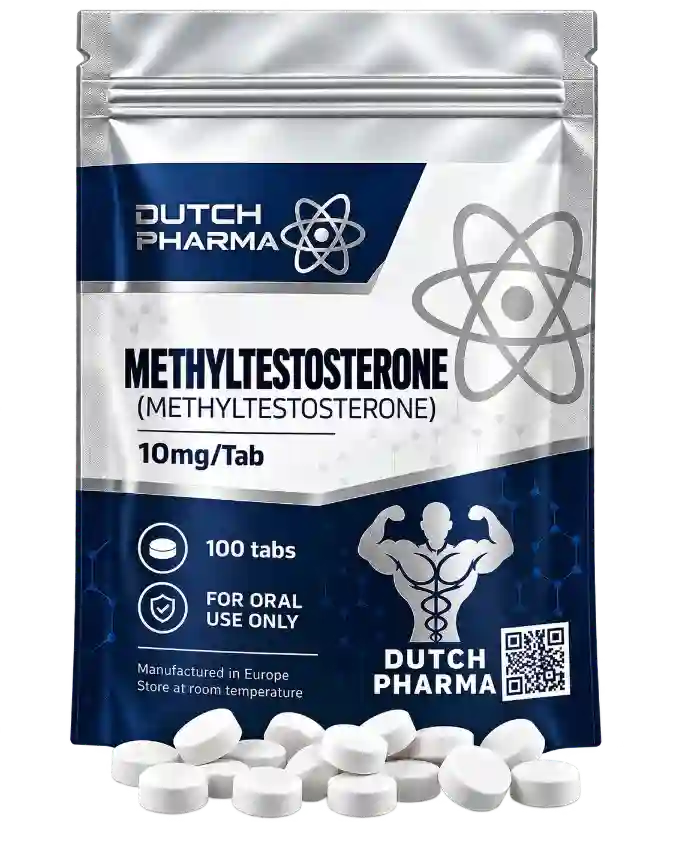


Methyltestosterone 10 mg represents a chapter in hormone research that dates back almost a hundred years. Shortly after chemists first isolated testosterone, they found that the pure hormone had little effect as a tablet. Methyltestosterone was their answer to this problem. It became the first androgen that could simply be swallowed and remained in use in many doctors’ offices for decades.
Today, the active ingredient plays hardly any role in medicine. The main reason is the liver. On this page, you will learn how a tiny change to the molecule made the tablet form possible and why that very change became a problem. We also explain which laboratory values can shift, which medications are incompatible with it, and which laws apply in Germany. No prior knowledge is needed.
Methyltestosterone at a glance
- Origin: Testosterone with an additional methyl group, first produced in the mid-1930s.
- Form: Tablet containing 10 mg of unesterified active ingredient for oral use.
- Former uses: Testosterone deficiency, delayed puberty, and certain forms of breast cancer.
- Main risk: Bile stasis in the liver, as well as unfavorable blood lipids and hormonal side effects.
- Legal status: No currently approved product in Germany; explicitly listed in the Anti-Doping Act.
A small change to the molecule
When you swallow testosterone, it first passes through the liver. Everything absorbed from the intestine flows there first via the portal vein. Experts call this the first-pass effect. With natural testosterone, this first pass is almost devastating. The liver breaks down the hormone so quickly that hardly any reaches the rest of the body.
Methyltestosterone bypasses this obstacle with a simple trick. In testosterone, a hydroxyl group and a hydrogen atom are attached to carbon atom 17. If this hydrogen atom is replaced with a methyl group—a small unit made up of carbon and hydrogen—an important liver enzyme can no longer attack the site so easily. A significant portion of the hormone survives the first pass and reaches the bloodstream.
What the body does with methyltestosterone
Apart from the methyl group, the substance closely resembles its counterpart. It therefore undergoes similar transformations. The enzyme aromatase converts it into 17α-methylestradiol. This estrogen is comparatively potent and is also broken down slowly. As a result, side effects associated more commonly with female hormones may occur.
A second enzyme, 5α-reductase, converts methyltestosterone into Mestanolone. This is, in a sense, the methylated version of dihydrotestosterone. Mestanolone acts mainly in the skin, hair follicles, and prostate. Both conversions explain why methyltestosterone is not a pure muscle hormone in the body, but instead has a broad range of effects.
Short duration of action
Methyltestosterone does not remain in the blood for long. Older studies report a half-life of about three hours. After this time, about half of the amount in the blood has disappeared. Most breakdown products are excreted via the kidneys, although some can still be detected long afterward.
The story of the first testosterone you could take by mouth
In 1935, several research groups succeeded in isolating and synthesizing testosterone. The Swiss chemist Leopold Ružička was working with the pharmaceutical company Ciba at the time. His group also described the methylated counterpart at almost the same time. For his work on sex hormones, Ružička shared the 1939 Nobel Prize in Chemistry with the German biochemist Adolf Butenandt.
The first medicines containing methyltestosterone came onto the market in the late 1930s. This was a major advance for doctors. Until then, male hormones had to be injected or implanted under the skin as pellets. A tablet was more convenient, and a whole range of products emerged in the United States and Europe. One well-known American brand name was Android. The 10 mg strength was quite common, unlike with some other oral steroids, whose current doses never corresponded to those of a medicine.
Buccal lozenges
Early on, researchers sought a way to bypass the liver even more effectively. One solution was so-called buccal tablets. They were placed between the cheek and gums, where they dissolved slowly. The active ingredient then passes directly into the bloodstream through the oral mucosa. This form was considered more effective than a swallowed tablet. In practice, however, it was unpopular because it had to remain in the mouth for a long time and interfered with eating or speaking.
What methyltestosterone was prescribed for in the past
The medical uses have changed over the decades. The following overview summarizes the main ones and shows their status today.
| Area of use | Background | Current status |
|---|---|---|
| Male hypogonadism | Replacement of missing endogenous hormones in disorders of the testes or pituitary gland | Medical societies advise against methylated tablets; gels, injections and unmodified testosterone are considered standard |
| Delayed puberty | Short-term treatment to initiate physical development in boys | Today, treatment is usually with testosterone esters as an injection or gel, with close monitoring of bone age |
| Breast cancer in women | Palliative treatment for certain advanced, hormone-dependent tumors | Replaced by modern antihormone therapies |
| Menopausal symptoms | Prescribed for a long time in the United States in combination with esterified estrogens | Never fully assessed according to current approval standards; of no significance in Europe |
Why medicine moved away from it
Two developments displaced methyltestosterone. On the one hand, reports of liver damage accumulated, particularly a characteristic form of bile stasis. On the other, better alternatives became available. Long-acting testosterone esters, patches, gels and, later, oral testosterone undecanoate delivered the natural hormone without placing this kind of burden on the liver. For years, guidelines from international hormone societies have recommended no longer using 17α-methylated androgens for testosterone deficiency.
The liver in focus
No other steroid is as closely associated with the term drug-induced cholestasis as methyltestosterone. In many liver disease textbooks, it serves as a classic example of how a medicine can disrupt bile flow.
Bile stasis explained simply
The liver produces bile every day. This fluid helps digest fat and also serves as a waste-removal route for substances such as bilirubin, a breakdown product of red blood cells. Tiny pumps in liver cells transport the components of bile into small channels. From there, it flows through the bile ducts into the intestine.
Methyltestosterone can slow these pumps. Bile then backs up in the liver cells and channels, even though there is no stone or narrowing. Doctors call this intrahepatic cholestasis. Typically, there is little inflammation, but bilirubin levels can rise significantly.
The disorder usually develops over a period of several weeks to months. In many cases, it resolves after the medication is stopped, although this can take a long time. Severe cases have also been described in the medical literature, in which the itching persisted for months or the bile ducts suffered lasting damage.
Blood-filled cavities and tumors
In addition to bile stasis, there are rarer but more serious findings. In peliosis hepatis, small, blood-filled cavities form in the liver. They often cause no symptoms, but can rupture and lead to internal bleeding. Liver adenomas have also been observed with prolonged use of methylated androgens. These are initially benign growths. In individual cases, doctors have also reported malignant liver tumors. How often this occurs cannot be accurately quantified due to the lack of large studies.
Other effects on the body
The liver is not the only organ affected. Methyltestosterone interferes with several regulatory systems that are normally finely balanced.
Heart and blood vessels
Oral androgens often lower HDL cholesterol, the type considered protective. At the same time, LDL cholesterol may rise. This shift occurs partly because enzymes involved in fat metabolism are more strongly activated directly in the liver. Possible fluid retention, increased blood pressure and a rise in red blood cell counts may also occur.
Hormone balance and fertility
The brain constantly measures how much male hormone is circulating in the blood. When it detects androgens introduced from outside the body, the pituitary gland releases less LH and FSH. Without these messengers, the testes reduce their own hormone and sperm production. For some people, it takes months after stopping for this cycle to return to normal.
Estrogenic and androgenic effects
- Breast tissue: The resulting methylestradiol can cause glandular tissue to enlarge in men.
- Skin and hair: Acne, oily skin and, in people with a hereditary predisposition, faster hair loss can occur.
- Prostate: Androgens can promote prostate growth; particular caution is advised if you have an existing condition.
- Mood: Irritability, sleep problems and mood swings have been reported.
Special groups
In women, methyltestosterone can cause masculinization. This can include a deeper voice, increased body hair and enlargement of the clitoris. Voice changes in particular are often permanent. The substance is contraindicated during pregnancy and breastfeeding because it can masculinize an unborn child. In children and adolescents, there is a risk that the growth plates in the bones will close too early, resulting in a shorter final adult height.
Which lab values may change
Many changes are not noticeable and show up only in blood tests. The table gives an overview of what doctors would monitor during or after previous use.
| Lab test | Possible change | What this means |
|---|---|---|
| Bilirubin | Elevated | May indicate impaired bile flow; above a certain level, it becomes visible as yellowing of the skin |
| Alkaline phosphatase, GGT | Elevated | Typical markers of bile stasis |
| ALT (GPT), AST (GOT) | Often only slightly elevated | Indicate damage to liver cells; after strength training, AST can also come from muscle |
| HDL and LDL cholesterol | HDL decreases, LDL increases | Unfavorable profile for blood vessels |
| Hematocrit, hemoglobin | Elevated | Thicker blood, putting greater strain on the heart and circulatory system |
| Total T4 (thyroid) | Decreased | Usually a measurement effect caused by lower levels of transport protein; free T4 often remains normal |
| LH, FSH, endogenous testosterone | Decreased | Signs of suppressed hormone production by the body |
Interactions with medicines
Methyltestosterone changes how the liver processes other medicines and which proteins it produces. This can lead to several known interactions:
- Coumarin-type blood thinners: The anticoagulant effect can become significantly stronger. The risk of bleeding increases.
- Insulin and diabetes tablets: Androgens can lower blood sugar, making existing treatments too potent.
- Corticosteroids: Combining them with androgens can increase the risk of fluid retention.
- Other substances that strain the liver: Alcohol, certain painkillers or other steroids can add to the strain.
Three common misconceptions
Claims about methyltestosterone circulate in forums and gyms that prove false on closer inspection.
“A small tablet can’t do much harm”
The figure 10 mg may seem harmless, especially compared with injections containing several hundred milligrams. But milligrams cannot be directly compared between different active ingredients. What matters is how potent a substance is and how it enters the body. With methyltestosterone, each tablet passes through the liver first and in high concentrations. This is precisely where the typical problems arise.
“It was once sold in pharmacies, so it must be safe”
Many medicines approved in the postwar era were assessed using standards that had little in common with today’s requirements. Large, controlled studies on long-term safety were rare at the time. The fact that a medicine was once prescribed therefore says little about how it would be assessed based on current knowledge. In addition, patients received the active ingredient under medical supervision and with blood tests.
“If you have no symptoms, your liver is healthy”
Liver tissue itself has no pain fibers. As a result, the liver can sustain damage for a long time without you noticing. Only a blood test or ultrasound can show the organ’s actual condition. By the time yellowing of the skin or itching occurs, the problem is usually already far advanced.
A look at fish farming
A very different use is less well known. In some countries outside Europe, methyltestosterone is added to the feed of young tilapia. The fish then develop predominantly as males and grow faster. In the European Union, the use of hormones to increase yields in farm animals is generally prohibited. Authorities therefore regularly test imported fish for such residues. For consumers, this is an example of how widely a single active ingredient can be used beyond the doctor’s office.
Methyltestosterone in sport
The World Anti-Doping Agency lists methyltestosterone by name among anabolic agents. It is therefore prohibited both in competition and during training. Modern laboratories detect not only the substance itself but also long-term metabolites. These breakdown products remain detectable in urine much longer than the original substance. Positive samples have also been found in athletes who had taken contaminated dietary supplements. Under sports law, however, athletes remain strictly responsible.
Legal status in Germany
Several sets of regulations apply to methyltestosterone at the same time. It is important to distinguish between them.
- Medicinal Products Act (AMG): There is currently no finished medicinal product containing methyltestosterone on the market in Germany. Anyone who manufactures, imports or supplies medicinal products without the required authorization violates the AMG.
- Anti-Doping Act (AntiDopG): Methyltestosterone is expressly listed in the annex to this Act. Among other things, it is a criminal offence to supply it for doping purposes in sport. Acquiring and possessing a quantity that is not small is prohibited even without the intention to sell. A separate regulation defines when a quantity is considered not small.
- Sports law: Regardless of criminal law, athletes in organized sports may face suspensions under the Anti-Doping Code.
Customs authorities deal strictly with shipments containing such substances. Even small quantities from abroad may be seized and lead to an investigation.
Frequently asked questions
Is methyltestosterone the same as testosterone?
No. It is a close relative with an additional methyl group. This group changes how the body processes the substance and causes the liver strain that does not occur in this form with the natural hormone.
Are there still testosterone tablets without a methyl group today?
Yes. Testosterone undecanoate in capsule form is absorbed through the lymphatic system, thereby bypassing some of the liver metabolism. It is approved as a medicinal product in several countries and is prescribed by a doctor.
Does liver damage heal?
Bile stasis is reversible in many cases, but recovery can take weeks to months. Structural changes such as adenomas or peliosis need medical monitoring, usually by ultrasound and regular blood tests.
Why does methyltestosterone have estrogen-like effects?
Because aromatase converts it into 17α-methylestradiol. This estrogen is broken down slowly and can therefore promote water retention or enlargement of the breast gland.
How long can methyltestosterone be detected?
The active substance itself disappears from the blood quickly. However, certain breakdown products remain detectable in urine for considerably longer. It is not possible to give a general timeframe, as this depends on the amount, duration, metabolism and testing method.
Conclusion
Methyltestosterone 10 mg contains an active substance with a long history. As the first androgen available in tablet form, it was a real breakthrough in the 1930s. Over time, however, it became clear that the very feature that makes it suitable for oral use places particular strain on the liver. Typical bile stasis, changes in blood lipids, hormonal side effects and interactions with blood thinners and diabetes medications have led medicine to favor other forms of testosterone today.
There is currently no approved product in Germany, and the Anti-Doping Act expressly names the substance. Anyone with questions about their health, such as liver values or hormone levels after previous use, can find competent and confidential support at a general practice, internal medicine practice or endocrinology clinic.